
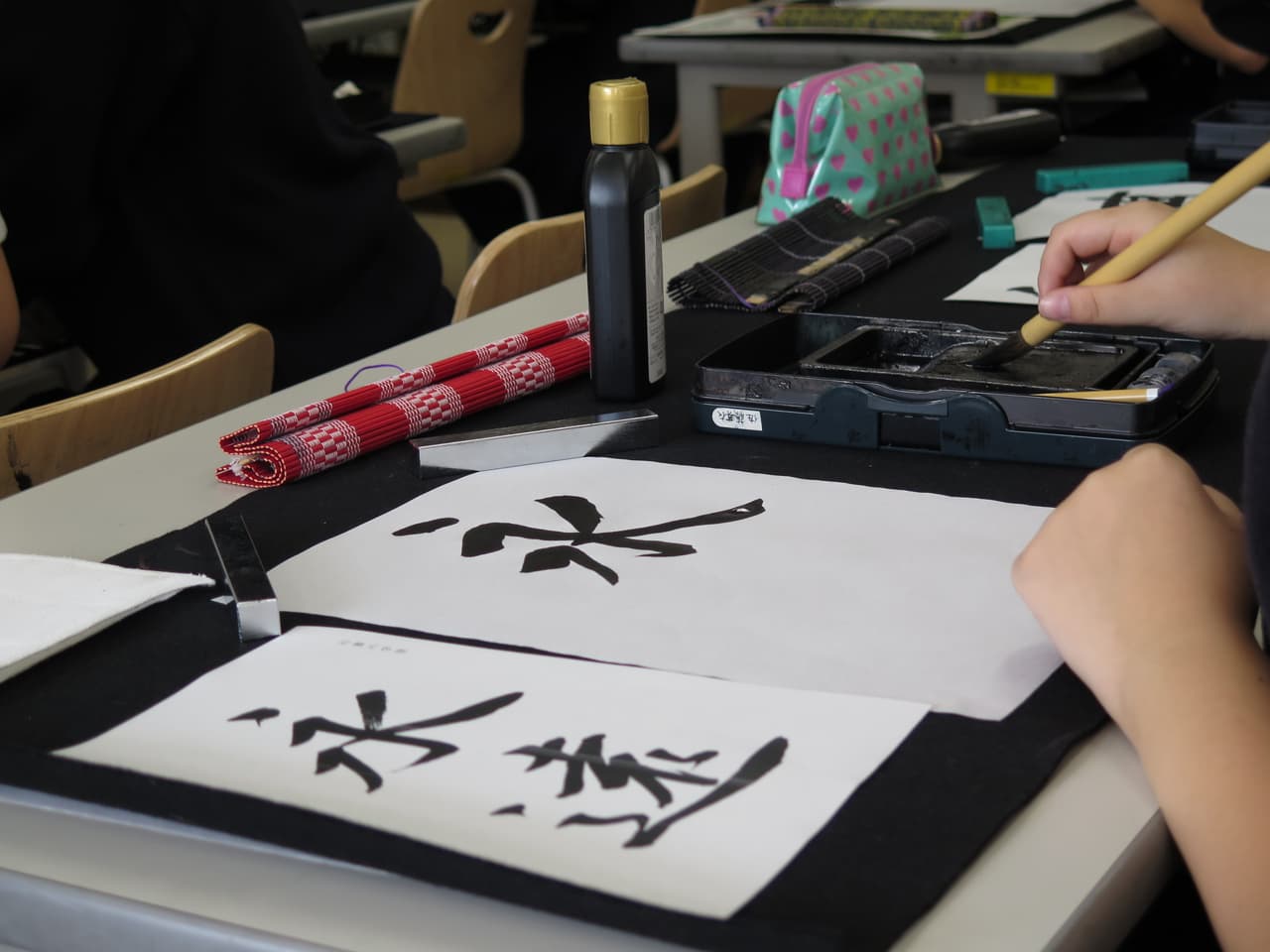
The short answer
*A Kyoto calligraphy class costs ¥6,500–¥25,000 per person and runs 50 minutes to 2 hours — and the real decision is not where, it is what you carry out of the room. A 50-minute workshop in Gion hands you your own sheet of writing. A two-hour studio course in Nakagyo-ku mounts your characters as a shikishi* board and a hanging scroll, then stamps both with a hanko you made yourself (the studio describes the hanko as a red seal rubber stamp). Every price, duration and access note below was read on the operator's own site as of 2026-09-23.
New to the art itself? Start with what shodō actually is, then come back here to book.
First decide the format, not the studio
Kyoto studios teach roughly the same hour — brush grip, posture, a few basic strokes, then your chosen kanji. What genuinely differs is the object you leave with, and that is what you will still have in ten years.
- 半紙 (hanshi) — a practice sheet. Thin calligraphy paper, rolled or folded into your bag. The cheapest outcome, and the most fragile.
- 色紙 (shikishi) — a paper board. Your writing pasted onto a stiff, gold-edged board that stands on a shelf without framing. This is the format most travellers actually want and most do not know to ask for.
- 掛軸 (kakejiku) — a hanging scroll. Your characters mounted on cloth-backed paper with rollers, so the piece hangs. One Nakagyo studio below mounts a full scroll inside the lesson; MK Taxi's class also lets you make a scroll of the practice kanji you write.
- Extras: 判子 (hanko) seal, 扇子 (sensu) folding fan, postcards. A carved seal turns your own name into a stamp you keep using; a fan turns the lesson into a gift.
If the outcome is the point, say so when you book — several studios run the format as a separate, differently-priced course rather than an upgrade you can add on the day.
The operators, honestly compared
| Studio | Area / access | Length | Price per person | Language | What you take home |
|---|---|---|---|---|---|
| Malligraphy — Japanese calligraphy workshop | Gion; 10-min walk from Keihan Gion-Shijo Stn, 1 min from the Chion-in-mae bus stop | 50 min | ¥6,500 adult / ¥5,500 under 12 | Conducted in English | Your finished artwork |
| Malligraphy — stone seal carving | same | 1.5 h | ¥10,500 adult / ¥7,000 under 12 | Conducted in English | A stone seal you carved, stamped on a postcard, boxed |
| Calligraphy Kyoto CHIFUMI — 1-hour Shikishi course | Nakagyo-ku, 199 Tawaraya-cho (Tominokoji Nijo-sagaru) | 1 h | ¥15,000 (tax incl.) | English / Mandarin / Japanese | A shikishi board you mounted yourself |
| CHIFUMI — 2-hour Hanging Scroll & Hanko course | same | 2 h | ¥25,000 (tax incl.) | same | Shikishi + hanging scroll, stamped with your own handmade hanko |
| CHIFUMI — 2-hour Special (hanko / sensu / sutra) | same | 2 h | ¥20,000 (tax incl.) | same | One of: carved seal, folding fan, or a copied sutra |
| SAKURA (Roxcy Inc.) — Shodo calligraphy class | Two classrooms: Nijo Castle (660 Ikezumi-cho, Nakagyo-ku) and Ninenzaka (349-19 Masuya-cho, Higashiyama-ku); 09:00–18:00, reservation required | about 60 min | Not published — enquire and they reply within 1 business day with a payment request | English | Your own piece; shodō materials included |
| Deeper Japan — Foundational Calligraphy | Nakagyo-ku; "15 minutes by car from Kyoto Station" | 1.5 h | From $320 (minimum 2 guests; a solo guest pays the 2-person rate) | Japanese, with a Deeper Japan guide interpreting | Your own work, taught by a university professor of calligraphy and standing director of the Japan Calligraphy Institute |
| MK Taxi — Shodo lesson near Kyoto Station | Near Kyoto Station | 1 h | Quotation only — no public price | English instruction included | Your name on calligraphy paper, a folding fan, a postcard, plus a gift envelope or a photo frame, and a scroll of the kanji you wrote |
How to read that table. Malligraphy has the lowest published price here and is the only one whose child rate is published — it is the family and short-on-time answer. CHIFUMI is the one to book if the mounted object is the reason you are going: the scroll and the seal are inside the ¥25,000 course, not sold on afterwards. Deeper Japan buys you the teacher rather than the souvenir, and is the only one that is not delivered in English directly. MK Taxi lists the longest set of included souvenirs here, but will not quote a price until you ask.
Three booking facts we checked on 2026-09-23
Go-info rots, so here is what the pages actually said on the day:
- CHIFUMI's online reservation form was closed. The booking form page returned "予約受付期間外です" (outside the reservation period). The studio's own text says same-day is sometimes possible but advance booking is preferred — so use the inquiries page, not the form.
- MAIKOYA's dedicated Kyoto calligraphy plan page was gone. It returns "This plan is currently unavailable." Their culture page still describes a 90-minute English calligraphy workshop at the Kyoto venues, so email the branch before you build a day around it: MAIKOYA's own site footer lists nishiki@maikoya.com for Kyoto Nishiki and gion@maikoya.com for Kyoto Gion.
- Lead times differ more than prices do. Deeper Japan asks for at least 7 days; MK Taxi's last reservation is 1 day before, with afternoon slots at 15:00, 16:00, 17:00 and 18:00 (the page adds that other times are possible on request); Malligraphy takes bookings through an online calendar on its own site, so check the live dates there.
Booking Japanese cultural experiences in general has its own traps — we wrote those up separately.
Where to buy brushes and ink in Kyoto
You will want your own brush roughly five minutes after the lesson ends. The unambiguous answer in Kyoto is Kyukyodo's head store on Teramachi at Anekoji, Nakagyo-ku (〒604-8091 京都市中京区寺町姉小路上ル下本能寺前町520, tel 075-231-0510). Founded in 1663, it describes itself as a specialist in the bunbō shihō — the "four treasures of the study": brush, ink, inkstone and paper — and its own product pages list brushes, inksticks and pigments, inkstones and paper as separate departments. Opening hours are 10:00–18:00, closed 1–4 January, with 31 December closing at 17:00.
A caution that applies to every shop: a beginner's brush and a collector's inkstone are different purchases by an order of magnitude, and Kyukyodo does not publish per-item prices online. Decide your budget before you walk in, and ask staff for a shodō practice brush rather than pointing at the beautiful thing in the case.
Two of our own guides are worth reading before you spend: how Japan's best-known brushes are actually made, in Kumano, and where Kyoto's handmade washi comes from — the paper is half the result.
Etiquette and what to wear
- Ink does not come out. Sumi stains permanently. Wear sleeves you can push up and clothes you would not mourn; leave the white linen at the hotel.
- Expect a low table. Kyoto studios generally work at floor level on tatami; MAIKOYA, for example, states plainly that cushions are provided for seiza so you do not have to kneel formally. If your knees are a problem, say so when booking rather than on arrival.
- Take your watch and bracelets off. The writing arm moves from the shoulder, and metal on the wrist drags across wet paper.
- Do not rush the finished sheet. Wet ink needs several minutes flat; a shikishi or scroll is assembled after it dries, which is exactly why the two-hour courses are two hours.
- If the piece is a present, say so early. Gift presentation is its own art in Japan — our omiyage etiquette guide covers how it will be wrapped and handed over.
Who this is good for
Good for: families with children (Malligraphy publishes an under-12 rate; MK Taxi accepts ages 6–80), couples wanting one quiet indoor hour, rainy afternoons, and anyone who wants a souvenir that is not a keychain.
Less good for: travellers on a tight budget who only want a photo — the cheap end of the classes compared here is ¥6,500, not ¥2,000. Solo travellers should also check minimums: Deeper Japan charges a lone guest the two-person rate.
Doing this in the other capital instead? See our Tokyo calligraphy classes. Building a whole Kyoto itinerary? Start from Kyoto's cultural experiences.
- Choose the format first: practice sheet, shikishi board, or a mounted hanging scroll — they are different courses at different prices, not day-of upgrades
- Malligraphy (Gion) has the lowest published price and is the only operator publishing a child rate: ¥6,500 adult / ¥5,500 under 12 for 50 minutes, conducted in English
- CHIFUMI's 2-hour ¥25,000 course is the only one here that finishes both a shikishi board and a hanging scroll and stamps them with a hanko you made yourself
- Checked 2026-09-23: CHIFUMI's online form was closed (use the inquiry page) and MAIKOYA's Kyoto calligraphy plan page returns "currently unavailable"
- Buy your own brush and ink at Kyukyodo's head store on Teramachi (founded 1663; 10:00–18:00, closed 1–4 January)
Sumi ink stains permanently — wear sleeves you can push up and clothes you would not mourn. Kyoto studios generally work at floor level on tatami (MAIKOYA states cushions are provided for seiza), so flag knee trouble when you book, not on arrival. Take your watch and bracelets off: the writing arm moves from the shoulder. Let the sheet dry flat before it is mounted — that drying time is exactly why the shikishi-and-scroll courses run two hours.
FAQ
- How much is a calligraphy class in Kyoto?
- ¥6,500 to ¥25,000 per person as of 2026-09-23. A 50-minute workshop in Gion is ¥6,500 for adults and ¥5,500 for under-12s; a two-hour studio course that mounts your writing as a shikishi board and a hanging scroll and stamps it with a hanko you made yourself is ¥25,000 (tax included). MK Taxi and SAKURA quote by enquiry rather than publishing a price.
- Can I get my calligraphy mounted as a hanging scroll in Kyoto?
- Yes. Calligraphy Kyoto CHIFUMI's 2-hour Hanging Scroll and Hanko course (¥25,000 per person, tax included) makes both a shikishi paper board and a hanging scroll and stamps them with a hanko you make yourself — the studio describes the hanko as a red seal rubber stamp. MK Taxi's lesson also lets you make a scroll of the practice kanji you write. Several other Kyoto classes send you home with a loose sheet instead, so ask for the format when you book.
- Are Kyoto calligraphy classes taught in English?
- Mostly yes, but not identically. Malligraphy's workshops are conducted in English and CHIFUMI teaches in English, Mandarin or Japanese, while Deeper Japan's class is taught in Japanese with a guide interpreting, and MK Taxi includes English instruction.
- Do I need to book a Kyoto calligraphy class in advance?
- Yes, and the lead times differ more than the prices do. Deeper Japan requires at least 7 days' notice, MK Taxi takes reservations until the day before, and Malligraphy books through an online calendar on its own site. CHIFUMI prefers advance booking and its online reservation form was showing "outside the reservation period" on 2026-09-23, so use its inquiry page. SAKURA replies to enquiries within one business day and confirms only after payment.
- Where can I buy calligraphy brushes and ink in Kyoto?
- Kyukyodo's head store on Teramachi at Anekoji in Nakagyo-ku (tel 075-231-0510), founded in 1663, is the standard answer: it is a specialist in the "four treasures of the study" — brush, ink, inkstone and paper. It opens 10:00–18:00 and closes 1–4 January. Per-item prices are not published online, so set a budget before you go in.