
Japanese Wedding Guest Etiquette: Gift Money (Goshūgi), the Envelope & What to Wear (2026)
Invited to a Japanese wedding as a friend or colleague? Bring ¥30,000 in brand-new bills in a white goshūgi-bukuro envelope with a musubikiri (awaji) knot, wrapped in a warm-coloured fukusa, and hand it over at the reception desk before the ceremony. Dress formal — never white, and not plain all-black. The after-party (nijikai) is a separate fee-based event with no envelope.
Everything below is sourced from Zexy's wedding manuals (several supervised by manners designer Noriko Iwashita), Recruit Bridal Research's 2025 survey, and the shrine and department-store guides listed at the end, all checked on 2026-10-11. Where we add our own advice, we say so.
How much to give: goshūgi by relationship
Japanese guests give cash, not presents. The amount is called goshūgi (ご祝儀) and depends on your relationship to the couple. The "going rate" column is Zexy's manual; the "measured average" column is the per-guest amount actually received, from the trend section (トレンド編) of Recruit Bridal Research's 結婚マーケット調査2025 (published 2026-01-22): 817 men and women aged 20–49 who held a ceremony, reception or wedding meal in Japan between April 2024 and March 2025. Each average rests on a smaller group of respondents — friend 147, relative 171, boss 67, colleague 58 — so treat the boss and colleague figures as rough.
| Your relationship to the couple | Going rate (Zexy manual) | Measured average (Recruit 2025) |
|---|---|---|
| Friend | ¥30,000 | ¥29,000 (80.1% gave ¥30,000–39,999) |
| Work colleague | ¥20,000–30,000 | ¥30,000 |
| Boss or subordinate | ¥30,000–50,000 | Boss: ¥42,000 |
| Relative (sibling, cousin) | ¥30,000–100,000 | ¥48,000 per relative |
| Attending as a couple (one envelope) | ¥50,000 (or ¥70,000) | — |
| Ceremony-only invitation, no reception | about ¥10,000 | — |
Four rules sit behind that table:
- Odd numbers only. Zexy and the Takashimaya gift guide both explain that even amounts "split" (割り切れる = parting). Exceptions: ¥20,000 is now widely accepted as "a pair" (both sources), ¥80,000 is lucky (末広がり, Zexy), and ¥100,000 is fine (Zexy). Avoid ¥40,000 (4 = death, Takashimaya) and ¥90,000 (9 = suffering, both sources).
- New bills, always. Zexy says to swap them early at a bank or post office; Takashimaya notes bank counters only do this on weekdays during the day. New bills show the gift was prepared with care.
- Why ¥30,000? Zexy breaks it down: the couple spends an average of ¥21,400 on your food and drinks plus about ¥6,000 on your hikidemono gift bag (Zexy Wedding Trend Survey 2024), so ¥30,000 is "costs plus a little celebration". ¥10,000 from a reception guest leaves the couple out of pocket.
- Young guests: Takashimaya says ¥20,000 is fine when the giver is young and the couple are their boss or colleagues; Zexy accepts ¥20,000 in general ("2 = pair is no longer seen as a problem").
If you cannot attend. Declined from the start: about ¥10,000 (the going rate minus the cost of your meal). Zexy's manuals give the timing both as "ideally by a week before" and "after the wedding", and say a present or congratulatory telegram alone is not rude if you are not close. Accepted and then cancelled: give the full planned amount (or ¥20,000–30,000) at least a week before, in person or by cash-registered mail (現金書留), because catering cancellation fees fall on the couple. If you mail it, enclose a short letter apologising for your absence; if you hand it over in person, Zexy says no letter is needed — apologise properly there and then. Living abroad? None of the sources above covers this case, so this is our editorial suggestion: ask a mutual friend in Japan to hand it over, or send a gift and say so in your note.
Fee-based weddings (会費制). Some invitations state a fixed fee instead. Mitsukoshi Isetan's guide gives ¥5,000–15,000 as the typical fee for a fee-based wedding, and notes in a separate section on regional differences that fee-based weddings have long been the norm in Hokkaido. As a rule no separate goshūgi is needed (Zexy; Mitsukoshi Isetan says "in principle"). Exceptions: Mitsukoshi Isetan adds that relatives, or seniors you owe a great deal, sometimes wrap a separate gift, and that relatives usually do — so if you are a relative, ask your parents or family what is customary. The two sources differ on how to hand the fee over: Zexy says to pay it in cash at the desk and not to wrap it like goshūgi, while Mitsukoshi Isetan says to bring it in a goshūgi envelope or a plain white envelope rather than paying straight from your wallet. Follow the invitation if it says; if unsure, ask the organiser or the couple.
The envelope: choosing, writing and folding
Choose the goshūgi-bukuro by the amount inside — Zexy's guide is roughly "1/100 of the cash".
- Knot (mizuhiki): red-white or gold-silver cord tied in a musubikiri, awaji or wa-musubi knot — a knot that cannot be re-tied, meaning "once only". Never a bow (chō-musubi), which is for repeatable celebrations like births. The envelope must have a small noshi ornament at the top right; envelopes without one are for hospital visits.
- Colour: white is formal; colourful or Western-style envelopes are for close friends only.
- Match the amount: ¥50,000+ → ornate awaji/wa-musubi knot on good washi; ¥20,000–30,000 → standard musubikiri/awaji; ¥10,000 (e.g. when you cannot attend) → a printed knot is fine.
- Front (表書き): the top says 寿 (kotobuki) or 御結婚御祝. If writing it yourself, avoid four characters (結婚御祝) — add 御 to make five. Write your full name below, slightly smaller than 寿, with a brush pen in thick black ink; no ballpoint. Up to three people can write their full names on one envelope (four or more: a representative's name plus 外一同); a married couple writes the husband's full name on the right and the wife's given name to the left.
- Inner envelope (中袋): amount on the front in formal kanji numerals — 壱萬円 (10,000), 弐萬円 (20,000), 参萬円 (30,000), 伍萬円 (50,000), 拾萬円 (100,000) — and your address and name on the back. The couple use this to see who gave what after the wedding, so never leave it blank.
- Bills: all facing the same way, face up with the portrait at the top when the inner envelope is opened.
- Outer fold: on the back, the bottom flap overlaps the top flap ("catching happiness"). Top-over-bottom is the funeral fold. Photograph the envelope before you open it and re-fold the same way.
- Fukusa: carry the envelope in a fukusa cloth or case in a warm colour (red, pink, orange, beige; purple works for both happy and sad occasions). Blue, green or grey is for funerals. No fukusa? Zexy says a large, clean, ironed handkerchief folded the same way will do; Takashimaya also accepts a small furoshiki.
What to wear as a guest
Men: a black formal suit (礼服) or a dark navy/charcoal suit, white plain shirt (no button-down, no short sleeves even in summer), a silver-grey, pale or striped tie — never a black tie, which is mourning dress. White pocket square, black lace-up straight-tip or plain-toe shoes, black socks. No boots, sneakers or hats. "平服でお越しください" on the invitation means dark suit, not casual.
Women: a dress or two-piece in any colour except white or near-white (pale yellow included); if you wear black, choose a design with frills or add accessories so it does not read as mourning (Zexy). For a daytime wedding keep it modest: ideally sleeves and a skirt that covers the knees; a sleeveless dress is fine if it does not show much shoulder, as long as you bring something to put over it (Zexy). Shoulder-baring dresses are fine in the evening. Avoid cotton, linen and knits (too casual), fur — even faux — reptile leather and animal prints beyond a small accent, black stockings or tights, bare legs and boots. Thin heels and natural-tone stockings complete it.
Wearing kimono as a guest. Formal kimono are welcomed: furisode (unmarried women; choose a mid- or small-sleeve furisode, not the bride's large one), hōmongi, iro-muji or tsukesage (semi-formal kimono that Zexy lists as suitable for weddings), kuro-tomesode for mothers and married female relatives, and iro-tomesode (a married woman's formal wear, which Zexy recommends for weddings at formal hotels and venues). Komon, tsumugi and yukata are generally not suitable for a wedding (Zexy). Renting is possible, but check the plan: our Asakusa and Nara rental guides cover sightseeing plans and do not list formal kimono, while our Osaka guide lists shops with furisode plans. Before booking anywhere, ask the shop whether it rents hōmongi, iro-muji, tsukesage or furisode, tell them it is for a wedding, and book hair-set with the dressing — a komon or other casual plan is generally not suitable. A Kyoto kimono photoshoot is a separate tourist product, not wedding dress.
On the day: desk, seat, speeches, gift bag, timing
- Reply first. Return the RSVP card within a week (Zexy). The names on the invitation are the guest list: Zexy explains that a joint address (連名) means a couple or family is invited. Our editorial advice: do not bring a partner who is not named — ask the couple first.
- Arrive 30 minutes early. Zexy's timeline: the reception desk opens about 30 minutes before the ceremony; the ceremony itself takes about 30 minutes (shrine, chapel or civil-style alike); the reception runs about 2.5 hours, plus a send-off of about 30 minutes. Zexy puts a guest's total time at roughly 3–5 hours.
- At the desk. Take the fukusa out of your bag before you reach the line, open it so it unfolds to the right, place the envelope on the folded cloth, rotate it clockwise so the recipient can read your name, bow and say 「本日はおめでとうございます」, then sign the guest book. If you gave your goshūgi earlier, say so and sign only.
- Seating card and speeches. Your seat is fixed by the seating chart. The first 25–30 minutes — entrance, opening words, introductions, the guest-of-honour speech and the toast — are formal, so stay seated and listen; the meal starts after the toast.
- Hikidemono. The couple give every guest a return gift (引出物・引菓子; Zexy puts the average spend at about ¥6,000 per guest) — it is yours to take home.
- No wrapped present at the venue. Cash is the gift. If you want to give a physical present as well, Zexy says hand it over or ship it no later than a week before the wedding — not on the day — and keep the total within the going rate.
Nijikai: the after-party is a separate, paid event
Many weddings are followed by a nijikai (二次会) at a restaurant, café or bar. It is fee-based (会費制): you pay the fixed amount on the invitation at the reception table in exact change — new bills are not needed, no envelope, and no separate goshūgi (Zexy and Mitsukoshi Isetan agree). Dress to the venue: wedding-level at a hotel, a notch down at a restaurant, smart at an izakaya — but the wedding taboos (white, sneakers, boots) still apply. Check your invitation for the fee and dress note.
What you will actually see: three ceremony styles
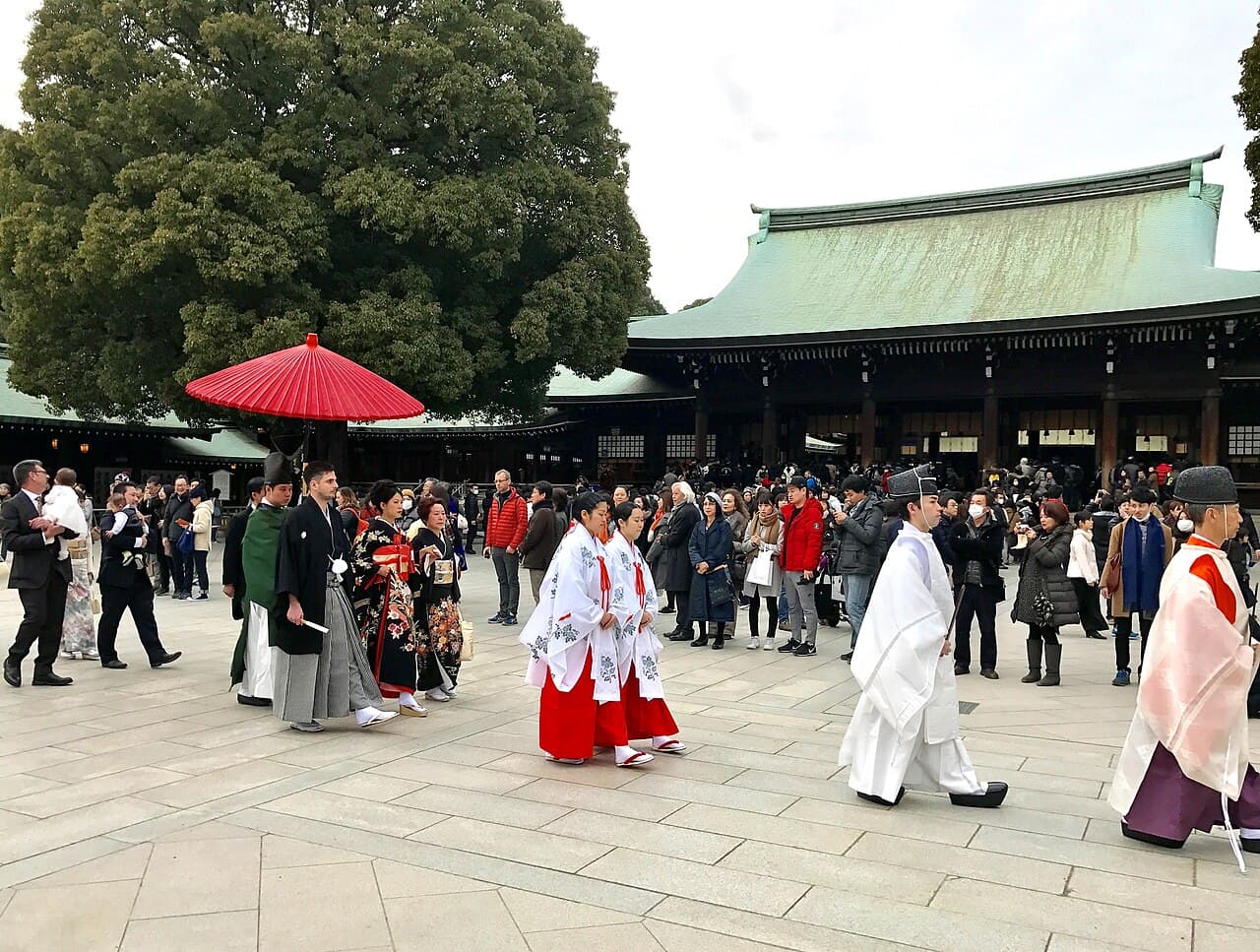
Shinzen-shiki (shrine). Despite its "ancient" image, the shrine wedding as guests see it today took shape in the Meiji era: Tokyo Daijingū says it created the Shinto wedding for the general public to commemorate the 1900 (Meiji 33) wedding of the Crown Prince. Zexy adds that what Hibiya Daijingū — today's Tokyo Daijingū — held that year was a mock ceremony, and that the first actual shinzen-shiki took place the following year. In 20–30 minutes you will see: purification (修祓), the priest's norito prayer, the san-san-kudo exchange of sake cups (三献の儀), the groom reading the vows (誓詞奏上), in some venues a ring exchange, the couple offering a sakaki branch with two bows, two claps and one bow (玉串奉奠), and a final shared sake for both families (親族固めの杯). Some shrines admit family only, but Zexy notes many now welcome friends — stand and bow when the room does. For why claps belong at a shrine and not a temple, read Temple vs shrine in Japan.
Chapel (教会式). A Christian-style ceremony, most often held in a hotel or wedding-hall chapel. The order is fixed, and it also takes about 30 minutes. Stand and sit when the officiant indicates.
Jinzen-shiki (人前式). A non-religious ceremony where the guests are the witnesses: typically vows, a ring exchange, signing a marriage certificate and a declaration that the marriage is made. The programme is free-form and can be short.
Whichever style, the reception that follows is the main event for guests: entrance, a guest-of-honour speech, toast, meal, cake cutting, the couple's outfit change (お色直し), friends' speeches or performances, the bride's letter, and the families' thanks (Zexy's reception timeline).
Numbers & sources (checked 2026-10-11)
- Zexy wedding manuals (Recruit; the goshūgi-rate, envelope, fukusa, dress, nijikai and gift-timing pages are supervised by manners designer Noriko Iwashita, the others are not): goshūgi rates by relationship, choosing, writing and folding the envelope, fukusa colours and hand-over, when and how to hand it over, women's dress, men's dress, nijikai guest manners, joint invitations, gift timing, how long a wedding takes, what a shinzen-shiki is. Per-guest cost (¥21,400 + ¥6,000) and the ¥30,000 / ¥44,000 / ¥77,000 averages are from the Zexy Wedding Trend Survey 2024 as quoted in those manuals.
- Recruit Bridal Research, 結婚マーケット調査2025 report (PDF), published 2026-01-22. All figures here come from its trend section (トレンド編): 817 men and women aged 20–49 who held a ceremony, reception or wedding meal in Japan between April 2024 and March 2025 (the report's separate married-people sample of 821, 既婚編, is not used here). Average invited guests 57.2 when both ceremony and reception/party were held (47.4 overall); average total goshūgi received ¥1,801,000 among those who held both (n=161; ¥1,617,000 overall, n=230); per-guest averages friend ¥29,000 (n=147), colleague ¥30,000 (n=58), boss ¥42,000 (n=67), relative ¥48,000 (n=171). It is a different survey with a different sample design from the Zexy Wedding Trend Survey 2024, so its figures are not directly comparable with the 2024 numbers above.
- Takashimaya, 結婚祝いの金額相場とマナー: odd-number rule, ¥20,000 for young givers, 4 and 9 taboo, new bills on weekdays, bill orientation, envelope fold, musubikiri, 寿 / 御結婚御祝, kanji numerals, warm-coloured fukusa.
- Mitsukoshi Isetan, 会費制結婚式のお祝いマナー: fee-based weddings ¥5,000–15,000, Hokkaido custom, "the nijikai fee is enough".
- Tokyo Daijingū, 神前結婚式: the shrine's own account of creating the public shrine wedding after the 1900 (Meiji 33) imperial wedding.
- Hikawa Shrine in Shakujii (石神井台 1-18-24; one of many shrines of that name), 式次第: order of a shrine ceremony (san-san-kudo, vows, tamagushi with two bows, two claps, one bow, family sake).
Rates are customs, not laws — when the invitation says something different, the invitation wins. Planning the trip around the wedding? Start with the best cultural experiences in Japan or, if the venue is in the capital, traditional experiences in Tokyo, and check the japan-event.info calendar for festivals on the same weekend.
Updated 2026-10-11: first published; all figures re-checked against the sources above on that date.
FAQ
- How much money should I give at a Japanese wedding as a friend?
- ¥30,000 in new bills. Zexy's manual gives ¥30,000 as the friend rate, and Recruit Bridal Research 2025 measured a ¥29,000 average, with 80.1% of friends giving ¥30,000–39,999.
- Can I give an even amount like ¥20,000 or ¥40,000?
- ¥20,000 is acceptable today ("a pair"); Takashimaya notes it is fine when the giver is young and the couple are their boss or colleagues. ¥40,000 and ¥90,000 are never acceptable (4 = death, 9 = suffering). ¥80,000 is fine.
- Can I wear black to a Japanese wedding?
- A black formal suit is the standard for men — just never with a black tie. Women may wear black, but an all-black, plain outfit looks like mourning; choose a design with frills or add accessories (Zexy). White is forbidden for every guest.
- Should I bring a wrapped present to the wedding?
- No. Cash in a goshūgi-bukuro is the gift. If you also want to give a present, Zexy says hand it over or ship it no later than a week before the wedding, not on the day.
- What if I can't attend?
- If you declined from the start, give about ¥10,000; if you are not close to the couple, a present or a congratulatory telegram alone is not rude. If you accepted and then cancel, give the full planned amount at least a week before — in person, apologising when you hand it over, or by cash-registered mail in Japan with a short apology letter (Zexy). If you are abroad, our editorial suggestion is to ask a friend in Japan to hand it over.