
The short answer
You can sit zazen in Tokyo, in English, from ¥400 — but on the temple's day, not yours. Tokyo has nothing like Kyoto's supply of English-guided Zen. What it has instead is a handful of genuine, cheap, well-run public sittings that locals attend, plus two great head temples just outside the city that hold dedicated English sessions for beginners.
If your dates are flexible, take the public sittings — they are better and cost almost nothing. If your dates are fixed, book a private session and accept that you are paying for scheduling, not for a better experience.
Where to sit
Kōun-ji (耕雲寺), Kinuta, Setagaya — ¥400. The most useful option inside Tokyo proper. Sittings run Saturdays 19:00–21:00 and Sundays 06:30–09:00, in Japanese and English, according to GO TOKYO, the city's official tourism body. The Saturday session takes walk-ins; the Sunday morning one wants a phone reservation the day before. Two hours for the price of a coffee, in a working neighbourhood temple.
Sōji-ji (總持寺), Tsurumi — ¥500. One of the two head temples of Sōtō Zen, on a campus so large it feels like a small town. It runs a monthly English zazen for beginners, with an optional guided tour of the grounds afterwards. About 25 minutes from Tokyo Station on the Keihin-Tōhoku Line. For the size and seriousness of the institution, ¥500 is close to absurd.
Tōkōzen-ji (東光禅寺), Kanazawa-bunko, Yokohama — ¥1,000. Sits on the second Sunday of most months (not January or August), runs about two hours, and needs no reservation.
Kenchō-ji (建長寺), Kita-Kamakura — ¥1,000 + ¥500 admission. Founded in 1253, Japan's oldest Zen training monastery. English zazen runs only five or six times a year, so it is a matter of luck — but it ends with tea and a question-and-answer session with the priests, which is the part people remember. Pair it with a Kamakura day and it justifies itself.
Private, paid sessions. Several Tokyo temples now host commercial English-guided zazen — Asakusa is the usual location — often finishing with matcha and sweets. They cost several times the public sittings. The honest case for them is scheduling and certainty, not depth.
What actually happens in a sitting
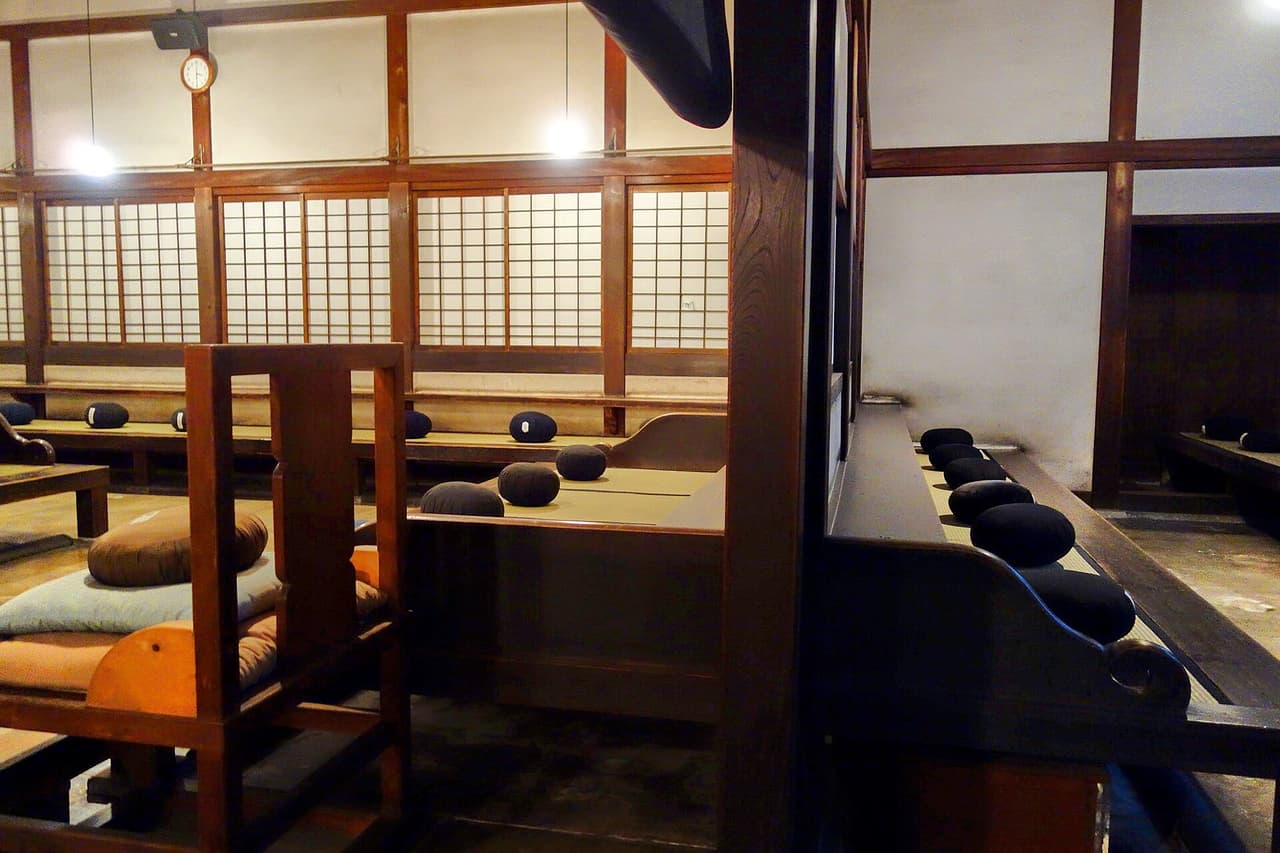
You arrive, leave your shoes and bag outside the hall, and are shown to a zafu (round cushion) on a raised platform. Someone demonstrates the posture: legs crossed or kneeling — or sitting in a chair, which is fine and offered almost everywhere — spine stacked, chin slightly in, hands in the hokkai jōin mudra with thumbs barely touching. Eyes stay half-open, aimed at the floor about a metre ahead. This surprises people. Closed eyes invite sleep and daydream; Zen wants you awake.
Then a bell, and silence. A first sitting is usually 15–25 minutes, sometimes two rounds separated by kinhin, slow walking meditation. Your legs will complain. Your mind will produce a shopping list. That is not failure — noticing it and returning to the breath is the practice, repeated a few hundred times.
At some point the kyōsaku may go round: a flat wooden stick carried by a monk. It is requested, not imposed. You bow, take a strike on the shoulder muscle to cut drowsiness, and bow again. Don't ask, and nothing happens.
Most sittings finish with a short talk and, at the friendlier temples, tea.
Practical rules that decide whether your trip works
- Arrive ten minutes early. Once a sitting starts, the door is closed. This is the single most common way visitors waste a morning.
- Wear something you can cross your legs in. Jeans are the classic error.
- Socks. Always.
- Phones off, not silent. A vibration in a silent hall is worse than a ring.
- No photographs in the zendō. Ask outside if you want a picture of the grounds.
Zen, Shingon, and what you are actually signing up for
Zazen is Zen practice — mostly Sōtō (shikantaza, "just sitting") or Rinzai (with kōan work). It is not the same as the Shingon esoteric Buddhism you meet on a Koyasan temple stay, where the practice you'll join is chanted liturgy and fire ritual rather than silent sitting. Both are worth doing; they are not substitutes. What is Zen sets out the difference, and wabi-sabi covers the aesthetic that grew out of it.
If you are heading to Kyoto and want a wider choice of English sittings, zazen in Kyoto has the temples, prices and booking links. And for what else is worth an early morning in the capital, see cultural experiences in Tokyo.
---
Prices, schedules and booking links on this page were verified as of 2026-08-09. Operators change them without notice — confirm on the booking page before you travel, and tell us if you find something out of date.
- Kōun-ji (Seijōsan Kōun-ji) in Kinuta, Setagaya sits twice a week — Saturdays 19:00–21:00 and Sundays 06:30–09:00 — for ¥400, in Japanese and English, per the city's own tourism board
- Sōji-ji in Tsurumi is one of the two head temples of Sōtō Zen and runs a monthly English zazen for beginners at ¥500, with an optional guided temple tour
- Tōkōzen-ji in Kanazawa-bunku, Yokohama sits on the second Sunday of most months (not January or August), ¥1,000, roughly two hours, no reservation needed
- Kenchō-ji in Kamakura — Japan's oldest Zen training monastery, founded 1253 — holds English zazen five or six times a year at ¥1,000 plus ¥500 admission, with tea and a Q&A afterwards
- Sitting in a chair is allowed almost everywhere, and half-lotus or simple cross-legged is normal for beginners; nobody expects full lotus
Arrive at least ten minutes early — once a sitting begins you cannot slip in, and being turned away at the door is the most common way visitors waste a trip. Wear socks. Keep phones off, not silent. Do not photograph inside the zendō. If the *kyōsaku* (the flat wooden stick) is used, understand that it is requested, not imposed: you bow, the monk strikes your shoulder to break drowsiness, you bow again. It is a courtesy between practitioners, not a punishment, and you can simply not request it.
Preguntas frecuentes
- Can you do zazen in Tokyo in English?
- Yes, but on fixed days rather than on demand. Kōun-ji in Setagaya sits Saturdays 19:00–21:00 and Sundays 06:30–09:00 for ¥400 in Japanese and English. Sōji-ji in Tsurumi and Kenchō-ji in Kamakura, both within an hour, run dedicated English sittings monthly and five-or-six-times-a-year respectively.
- How much does zazen cost in Tokyo?
- From ¥400 at Kōun-ji, ¥500 at Sōji-ji's English beginners' sitting, and ¥1,000 at Tōkōzen-ji or Kenchō-ji (the latter plus ¥500 temple admission). Commercially run private English sessions cost several times more.
- Do you need to book zazen in advance?
- Often not. Kōun-ji's Saturday sitting, and Tōkōzen-ji's second-Sunday sitting, take walk-ins. Kōun-ji's Sunday morning session needs a phone reservation the day before. Private sessions always need booking. Whatever you choose, arrive ten minutes early — you cannot join once a sitting has started.
- Does zazen hurt if you can't sit cross-legged?
- It shouldn't. Sitting in a chair is permitted at essentially every temple that teaches beginners, and half-lotus or a simple cross-legged position is standard for newcomers. Full lotus is not expected. Say so at the start and someone will bring you a chair or an extra cushion.
- What is the stick they hit you with?
- The kyōsaku. It is requested by the sitter, not imposed by the monk: you bow, receive a strike on the shoulder muscle to clear drowsiness or tension, and bow again. If you don't want it, don't request it and nothing will happen.