
Zen Gardens in Kyoto: What Karesansui Means and Which to See
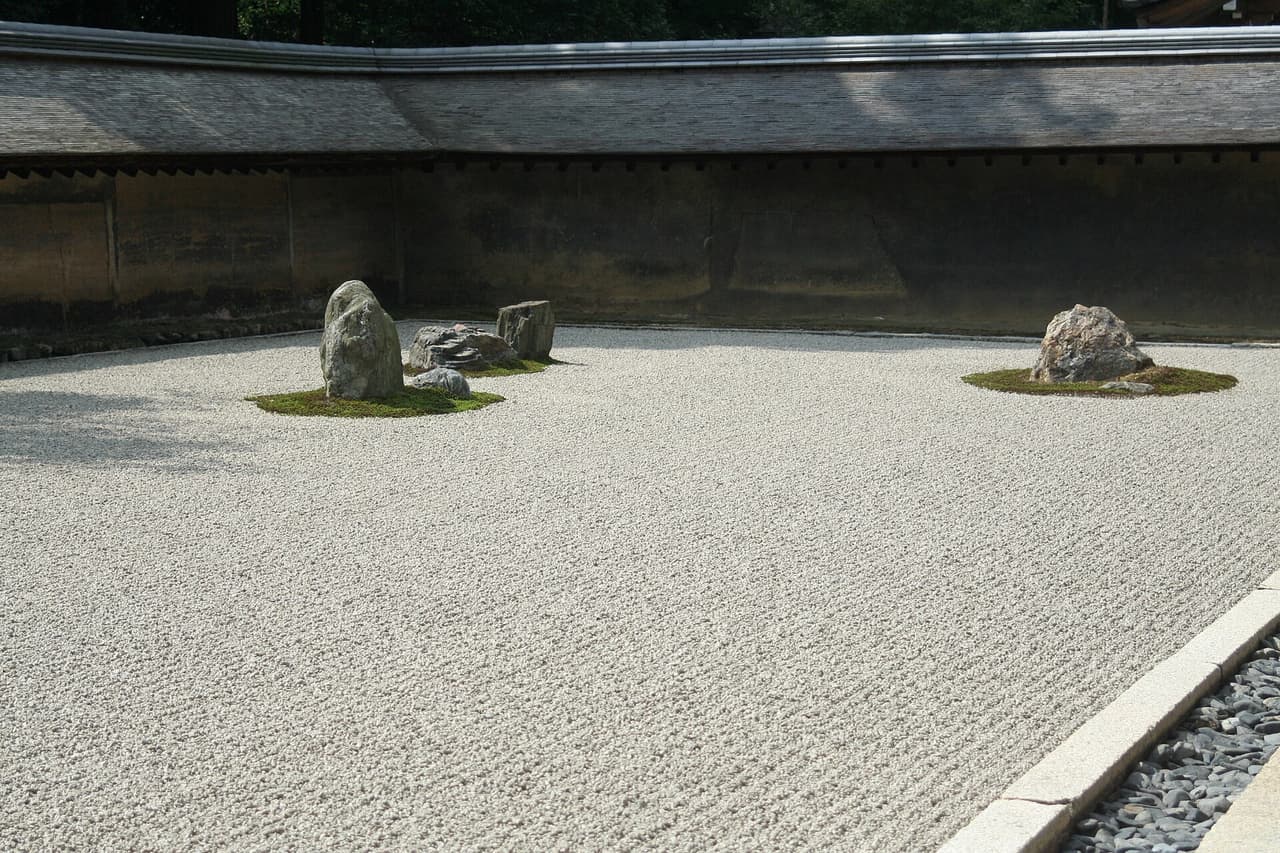
*A Kyoto "Zen garden" is a karesansui — a dry landscape that uses rock and raked gravel instead of water, meant to be viewed from a seated position rather than walked through.* Ryoan-ji is the one everybody means; Daisen-in and Tofuku-ji are the two that reward you for going further.
The word karesansui literally means "dry mountain water". Once you know that, the gardens stop being abstract: the gravel is water, the standing stones are mountains and islands, and the composition is a landscape seen from very far away.
Ryoan-ji — the one to see first
Ryoan-ji's rock garden is a rectangle of white gravel of roughly 250 square metres holding fifteen stones. The Japan National Tourism Organization states the defining fact plainly: "There is always one rock that is hidden from view, regardless of where the viewer stands." Fourteen at a time, never fifteen — from any position on the veranda.
What that arrangement means is deliberately unsettled; the garden invites interpretation rather than supplying one. That is the point, and it is worth resisting the tidy explanations you will hear in the queue.
The temple is Rinzai Zen, and the garden is part of the UNESCO World Heritage site Historic Monuments of Ancient Kyoto, inscribed in 1994.
Getting there (per JNTO): a 10-minute walk north from Ryoan-ji Station on the Keifuku Kitano Line, or the #59 bus from Sanjo Keihan Station to the Ryoan-ji-mae stop, which is directly in front of the temple.
Daisen-in — the garden that tells a story
Daisen-in, a subtemple of Daitoku-ji, was founded in 1509 by the Zen priest Kogaku Soko. Its garden does something Ryoan-ji refuses to do: it narrates.
Read it as a river's whole life. In the east garden, tall upright stones stand for deep mountain valleys, and "water" — white sand — begins there. It widens as it runs into the north garden, becomes a great river, and finally opens into an ocean. A landscape of that scale, compressed into a narrow L-shaped strip beside the abbot's quarters.
The hojo (abbot's quarters) itself is a designated National Treasure.
Tofuku-ji — the modern one
The Hojo garden at Tofuku-ji was created in 1939 by Mirei Shigemori (1896–1975), and it is the reason he is the most famous modern name in Japanese garden design. It was his first major Kyoto commission.
Shigemori called his work "concept gardens containing abstract expression". He set stones like sculpture and laid moss and paving in a checkerboard grid — a twentieth-century graphic sensibility inside a Zen temple. If Ryoan-ji feels like a riddle and Daisen-in like a story, Tofuku-ji feels like a designed object, and the three together show that karesansui never actually stopped evolving.
How to look at one (and not feel like you missed it)
- Sit down. These gardens are composed for a seated eye at veranda height. Standing and photographing is the surest way to see nothing.
- Stay longer than feels reasonable. Ten minutes is the difference between a rock rectangle and a landscape.
- Go early. Ryoan-ji is one of Kyoto's most visited temples, and a crowded veranda defeats a garden designed around stillness.
- Do not chase the fifteenth stone. You are not meant to find it.
Hours and admission change, so check each temple's official page before you go — as of 2026-08-19 we do not publish fees we cannot verify from the temples themselves.
Read next
- What Zen actually is — the school behind the gardens, and why "empty" is not the same as "minimal".
- What wabi-sabi means — the aesthetic these gardens are usually cited to illustrate.
- Temple vs shrine in Japan — so you know what you are walking into, and how to behave there.
- Washi paper-making in Kyoto — a hands-on Kyoto craft for the same trip.
자주 묻는 질문
- What is a Zen garden in Kyoto?
- It is a karesansui, or dry landscape garden, which uses rock and raked gravel instead of water and is designed to be viewed from a seated position on a veranda rather than walked through.
- How many stones are in the Ryoan-ji rock garden?
- Fifteen, set in a gravel rectangle of roughly 250 square metres. According to the Japan National Tourism Organization, one rock is always hidden from view no matter where the viewer stands.
- Can you see all 15 stones at Ryoan-ji?
- No. JNTO states that there is always one rock hidden from view regardless of where the viewer stands, so you see fourteen at a time from the veranda.
- Which Zen gardens should I visit in Kyoto?
- Ryoan-ji for the famous abstract rock garden, Daisen-in at Daitoku-ji for a garden that narrates a river running from mountains to the ocean, and Tofuku-ji for Mirei Shigemori's modern 1939 design.
- What does karesansui mean?
- It literally means 'dry mountain water' — a garden where raked gravel represents water and standing stones represent mountains and islands, with no actual water used.
- How do you get to Ryoan-ji?
- JNTO gives two routes: a 10-minute walk north from Ryoan-ji Station on the Keifuku Kitano Line, or the #59 bus from Sanjo Keihan Station to the Ryoan-ji-mae stop directly in front of the temple.
Try it yourself

ExperienceKyoto
교토 와시(和紙) 종이뜨기 체험 — 가족이 운영하는 종이 가게 '카미토와'(공식 예약 또는 에어비앤비 예약 가능)
교토 산조도리에 위치한 영어 응대가 가능한 소규모 와시 공방 '카미토와'에서 직접 종이를 떠서 엽서, 테이블 매트, 램프 갓 등으로 완성하는 체험. ¥3,000(세금 별도)부터, 약 1시간 소요. 공식 예약과 에어비앤비 예약 모두 가능.