
Onsen in Kyoto: Kurama, Arashiyama, Ohara and City Baths, With Tattoo Policies (2026)
Of the nine Kyoto baths whose official sites we checked on 2026-09-24, two clearly say guests with tattoos can bathe: Kurama Onsen, and Ohara no Sato if the tattoo is kept covered with a towel. Fufu no Yu and Sagano Onsen Tenzan no Yu in Arashiyama, Mibu Onsen Hana no Yu in the city and HOTEL KUU KYOTO near Kyoto Station officially refuse tattoos, and Kyoto Takenosato Onsen Manyo no Yu refuses them "as a rule" but admits guests who follow its house rules.
This page collects only what each facility's own website, and official government and trade-association pages, say about onsen and day-use baths in Kyoto City. We did not use review sites or "tattoo-friendly onsen" directories as sources. Where an official page says nothing, we write "not stated" or "could not confirm" instead of guessing.
Kyoto's onsen are easiest to choose in four groups: Kurama (north), Arashiyama and Sagano (west), Ohara (northeast) and the city itself. The city also has neighborhood public baths (sento) at ¥550, but "onsen" and "sento" are different legal categories (see sento vs onsen).
At a glance: area, day-use terms and tattoo policy (as of 2026-09-24)
Prices are per adult, tax included.
| Facility | Area and access | Day-use terms | Tattoos (official wording) |
|---|---|---|---|
| Kurama Onsen | Kurama; 10 min walk from Eizan Railway Kurama Station (free shuttle) | 10:00–21:00, no booking needed. Bath price not stated in the official page text | Allowed (not members of organized crime groups) |
| Fufu no Yu | Arashiyama; 1 min walk from Hankyu Arashiyama Station | 12:00–22:00 (last entry 21:30). Top page: ¥1,200 weekdays, ¥1,400 weekends/holidays; price page: ¥1,100 and ¥1,300 | Refused (tattoo stickers too) |
| Sagano Onsen Tenzan no Yu | Sagano; 3 min walk from Randen Arisugawa Station | 10:00–24:00 (last entry 23:00), closed 3rd Monday. ¥1,200 weekdays, ¥1,300 weekends/holidays | Refused (any size or design; stickers and body paint too; covering not accepted) |
| Minshuku Ohara Sanso | Ohara; about 13 min walk from the Kyoto Bus "Ohara" stop | Meal-and-bath set only, reservation required, weekends/holidays only for now. Bathing 11:30–15:30. Set meals from ¥2,200 plus ¥100 bathing tax | Not stated |
| Ohara no Sato | Ohara; from the Kyoto Bus "Ohara" stop toward Jakko-in | Current day-use terms could not be confirmed on the official site | Allowed with a condition (English page: keep covered with a towel) |
| Funaoka Onsen | Murasakino, Kita Ward (listed by the Kyoto public bath association) | 15:00–23:30 (Sundays from 8:00), closed Tuesdays. Association sento price ¥550 | Not stated |
| Mibu Onsen Hana no Yu | Mibu; 5 min walk from JR Tambaguchi Station | 10:00–25:00 (last entry 24:00), no regular closing day (closed 5–9 Oct 2026). ¥890 weekdays, ¥1,020 weekends/holidays | Refused (stickers and paint included) |
| Kyoto Takenosato Onsen Manyo no Yu | Oharano, Nishikyo Ward; about 12 min by bus from JR Katsuragawa Station | Open 24 hours (main baths closed 3:00–5:00 for cleaning). Set admission ¥2,730 plus ¥100 bathing tax | Refused as a rule (admitted if you follow house rules; ask staff) |
| HOTEL KUU KYOTO | About 7 min walk from Kyoto Station | Entry 6:00–9:30 and 15:00–21:30. Large bath ¥1,200, small bath ¥1,000. Water is "natural Kyoto groundwater" | Refused (tattoo stickers and body paint included) |
"Not stated" does not mean tattoos are fine. Ask the facility directly.
Tattoo policies: four ways the official pages put it
The wording differs a lot from one facility to the next.
- Allowed: Kurama Onsen's FAQ answers "Can I bathe if I have a tattoo?" with "Guests with irezumi or tattoos may use the facility. However, members of organized crime or anti-social groups are not admitted."
- Allowed with a condition: Ohara no Sato's English page says "Tattoos are allowed in our baths but we ask they remain covered with a towel." We found no tattoo statement on its Japanese pages.
- Refused as a rule, with an exception: Manyo no Yu "firmly refuses" tattoos, tattoo stickers and body paint, but adds that guests "who follow the rules set by the facility" are admitted, and tells you to ask staff for details. The rules themselves are not on the official page.
- Refused: Fufu no Yu ("we refuse bathing for guests with tattoos", including guests with tattoo stickers), Tenzan no Yu ("regardless of size or pattern"), Hana no Yu ("including stickers and paint") and HOTEL KUU KYOTO (tattoo stickers and body paint included).
On covering a tattoo, only Tenzan no Yu gives a clear answer: "Even if you cover your tattoo, you cannot bathe." The "tattoo sticker" and "paint" wording at Fufu no Yu, Hana no Yu and HOTEL KUU KYOTO targets stuck-on or painted tattoos themselves; none of the three mentions skin-colored cover patches.
One national document is relevant. In a notice dated March 16, 2016, titled (in translation) "Response to bathing by foreign travelers with tattoos", the Japan Tourism Agency said that, for foreign travelers with tattoos, refusing bathing solely because of a tattoo is not appropriate, and gave examples of what facilities can do instead: ask guests to cover the tattoo with a sticker, ask nothing special for a small (for example palm-sized) tattoo that does not intimidate other bathers, suggest times when fewer families bathe, or offer a private bath. The Ministry of Health, Labour and Welfare passed the notice to prefectures on March 18 (MHLW notice, PDF, in Japanese). The notice covers foreign travelers only; it is not a rule for every bather. It also asks each facility to "consider how to respond", and as the table shows, the actual rules differ by facility.
For Kyoto's sento, the "six don'ts" on the Kyoto public bath association's how-to page (no drunk guests, no diving or swimming, no towels in the water, tie up long hair, don't shower standing up, one locker per person) contain no tattoo item. That does not mean every sento admits tattoos; it means each bathhouse decides. Ask at the counter.
For the nationwide picture and how to ask a facility, see our onsen and tattoos guide.
Kurama: Kurama Onsen
A day-use onsen and inn at the foot of Mt. Kurama, a 10-minute walk from Eizan Railway's Kurama Station. A free shuttle bus runs daily between the station and the onsen; on Kyoto Bus routes 32, 50 and 52, get off at "Kurama Onsen". Parking: 30 spaces, free.
- Day use: 10:00–21:00, covering the indoor bath, sauna and open-air bath, plus the restaurant, café and lounge. No booking is needed, but some days are closed or reserved for private use, so the onsen suggests asking ahead.
- Water: officially listed as a simple hydrogen-sulfide (sulfur) spring.
- Bath rules: separate baths for men and women, not mixed. No swimsuits or clothing in the bath, and keep your towel out of the water.
- Private bath: there is no private open-air bath. Only overnight guests get a time slot in the baths after day-use hours end.
- Price: the official page text does not state the day-use bath price. Eizan Railway's "Eiden to Onsen Kippu" combines a one-day pass for all Eizan lines with a Kurama Onsen open-air bath ticket for ¥2,200 (adults only). It is sold at Demachiyanagi Station and in the "my route" app from April 1, 2026 to March 31, 2027, and gives ¥200 off at the onsen restaurant. The railway notes the onsen may close on some days for inspections.
For the Kurama Fire Festival, Kurama Onsen's notice of April 25, 2026 said an overnight plan would be sold through MK Travel, with prices still being arranged. For the festival itself, see our sister site's Kurama Fire Festival page (Japan-Event).
Arashiyama and Sagano: Fufu no Yu and Tenzan no Yu
Kyoto Arashiyama Onsen Fufu no Yu is a day-use bath 1 minute on foot from Hankyu Arashiyama Station (10 minutes from Randen Arashiyama, 20 from JR Saga-Arashiyama). It opens 12:00–22:00 (last entry 21:30), with no regular closing day but occasional closures. The official site lists the spring as Arashiyama Onsen, a simple spring at 35.2°C.
Check the price at the counter. As of 2026-09-24, the official top page showed ¥1,200 on weekdays and ¥1,400 on weekends and holidays, while the price page on the same site showed ¥1,100 and ¥1,300. The official pages do not say which is current. The FAQ refuses guests with tattoos, and guests with tattoo stickers too.
Sagano Onsen Tenzan no Yu is a 3-minute walk from Randen Arisugawa Station (3 minutes from the Kyoto Bus "Ikudaguchi" stop, about 25 minutes on foot from Randen Arashiyama). From Kyoto Station, Kyoto Bus routes 73, 75 and 76 take about 45 minutes.
- Open 10:00–24:00 (last entry 23:00); closed the third Monday of each month (the next day if that Monday is a holiday).
- Adults ¥1,200 on weekdays and ¥1,300 on weekends and holidays; children (age 4 to elementary school) ¥550; age 3 and under free. You can bathe as many times as you like during your stay.
- The water is a sodium-calcium chloride spring drawn from 1,200 m underground, with a carbonated bath on weekends and holidays.
- Tattoos of any size or design are refused, as are tattoo stickers and body paint, and covering them does not help.
Ohara: Ohara Sanso and Ohara no Sato
According to Ohara Sanso, Kyoto Bus is the only public transport to Ohara. Its access page lists about 60 minutes on route 17 from Kyoto Station, about 33 minutes on routes 16 or 17 from Demachiyanagi, and about 20 minutes on route 19 from Kokusaikaikan subway station; get off at "Ohara".
Minshuku Ohara Sanso is an onsen guesthouse that takes both overnight and day guests.
- Day use is a meal-and-bath set only; bath-only visits are not accepted. Book ahead; for now it runs on weekends and holidays only. Meals 11:30–14:30, bathing 11:30–15:30.
- Set meals (rice balls, mountain-vegetable soba or oden) are ¥2,200 for adults; miso hot pot is ¥3,900 (reservation). Guests of junior-high age and up pay a ¥100 bathing tax. Towels cost extra.
- There are two baths, one of cypress and one of rock, which swap between men and women. Beside the open-air bath, a Shigaraki-ware pot bath is filled with 100% source water on a semi-flow-through basis. The water is a weakly alkaline simple spring.
- The bath building is separate and reached by about 45 steps. If stairs are hard for you, ask in advance.
- We found no tattoo statement on the official pages.
Ohara no Sato is a guesthouse whose signature dish is miso hot pot made with miso from its sister shop, Misoan. Its onsen page says the spring comes from 1,175 m down at about 120 liters a minute and 27.9°C, and is heated in a recirculating system with no added water. Its open-air goemon (cauldron) bath fits about four people.
The English page allows tattoos covered with a towel, and allows swimsuits for guests who cannot bare their skin for religious or cultural reasons. We could not confirm current day-use prices and terms on the official site, so call ahead (075-744-2917).
In the city: sento, Funaoka Onsen, Hana no Yu, Manyo no Yu and near Kyoto Station
Sento prices: the Kyoto public bath association lists ¥550 for junior-high age and up, ¥200 for elementary-school children and ¥100 for infants; junior-high students pay ¥400 with a student ID. The ¥550 is Kyoto Prefecture's regulated bath price, raised from ¥510 on April 1, 2025 (Kyoto Prefecture announcement, in Japanese). A book of 10 adult tickets costs ¥5,300.
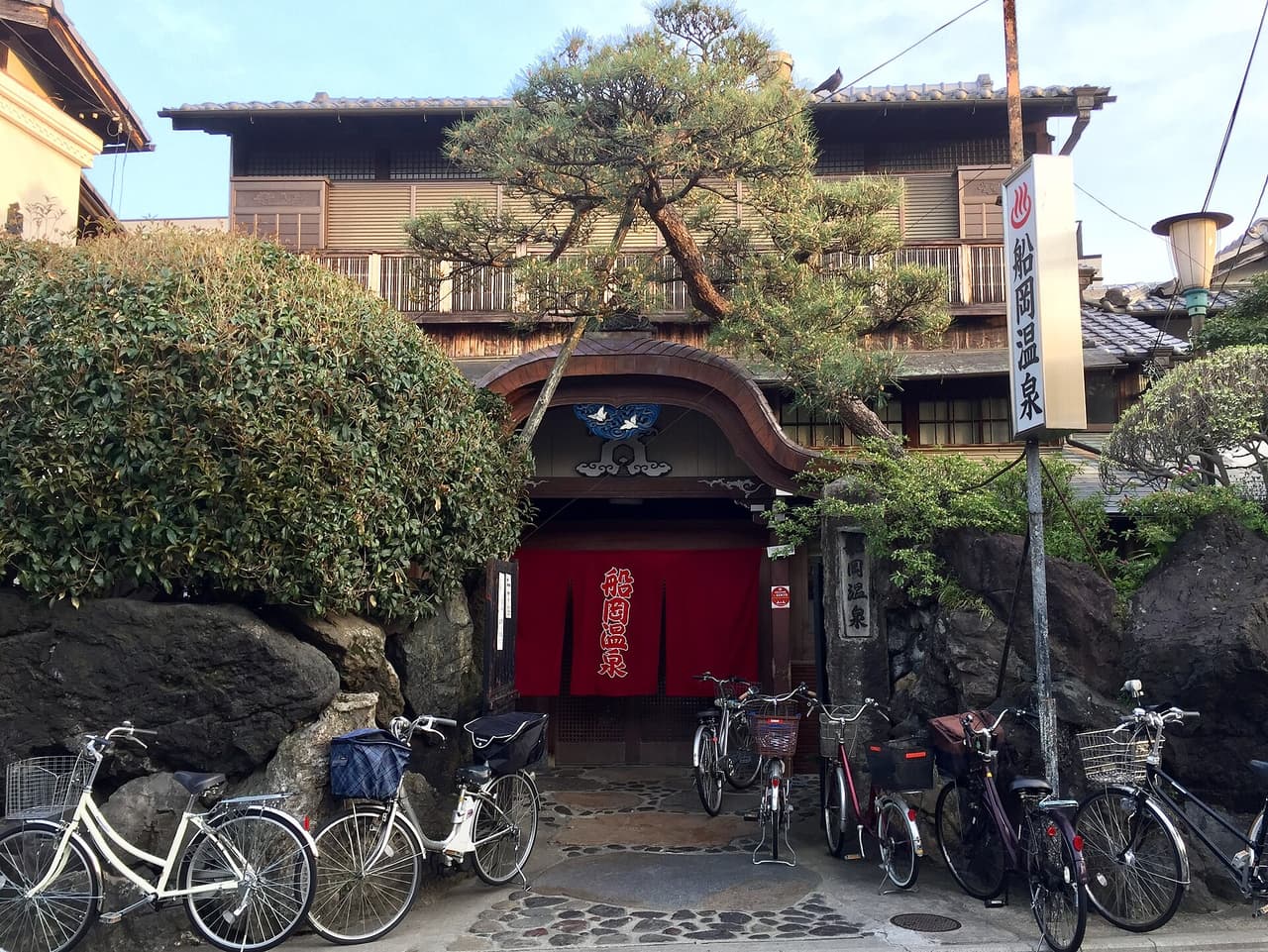
Funaoka Onsen (82-1 Murasakino Minamifunaoka-cho, Kita Ward) is a sento listed by the Kyoto public bath association: open 15:00–23:30 (Sundays 8:00–23:30), closed Tuesdays; the association's page lists an open-air bath, sauna, electric bath, cold bath and herbal bath among its facilities. Its dressing-room building is a Registered Tangible Cultural Property. The Agency for Cultural Affairs database says it was built in 1923 as a bathhouse attached to the Funaokaro restaurant-inn, and the curved karahafu gable facing Kuramaguchi-dori was added in 1928.
- Despite the name, we could not confirm from official sources whether its water is a legal onsen.
- There is no tattoo statement either. Call before you go (075-441-3735).
- Use the association's page for opening information.
Mibu Onsen Hana no Yu is a 5-minute walk from JR Tambaguchi Station (or take a city bus to "Kyoto Research Park-mae"). It opens 10:00–25:00 (last entry 24:00) with no regular closing day (the official guide page says open every day; only the in-house hair salon closes on Mondays). Adults pay ¥890 on weekdays and ¥1,020 on weekends and holidays; elementary-school age and under ¥370 and ¥420; age 2 and under free. The facility says the water in its open-air rock bath and pot bath is natural onsen water from a source in Moriyama, Shiga Prefecture. Tattoos, including stickers and paint, are refused. It is closed 5–9 October 2026 (official notice, checked 2 Oct).
Kyoto Takenosato Onsen Manyo no Yu is a 24-hour facility in Oharano, Nishikyo Ward, reached by bus from JR Katsuragawa or Hankyu Rakusaiguchi stations (access). Set admission (bath, yukata and towels) is ¥2,730 for adults plus a ¥100 bathing tax. A morning bath from 5:00 to 10:00 is ¥1,470, and staying past 3:00 a.m. adds ¥2,000 for adults. The main baths close 3:00–5:00 for cleaning. Its tattoo policy is the "refused as a rule, with an exception" wording above.
HOTEL KUU KYOTO, about 7 minutes on foot from Kyoto Station, lets non-guests use its large bath (with open-air bath, sauna and cold bath) or its small cypress bath. Since June 20, 2026 the large bath costs ¥1,200 and the small bath ¥1,000, with ¥100 off if you bring your own towel. Entry hours are 6:00–9:30 and 15:00–21:30. The hotel describes its water as "natural Kyoto groundwater" and does not call it onsen. Guests with tattoos, tattoo stickers or body paint are asked not to use the baths.
Which one should you pick?
| If you want to... | Try | Per the official pages |
|---|---|---|
| Use a shared bath with a tattoo | Kurama Onsen | FAQ allows tattoos |
| Stop by after sightseeing in Arashiyama | Fufu no Yu | 1 min from Hankyu Arashiyama (no tattoos) |
| Bathe late at night | Tenzan no Yu, Hana no Yu, Manyo no Yu | Last entry 23:00 / 24:00 / open 24 hours |
| Wash off near Kyoto Station | HOTEL KUU KYOTO | About 7 min walk (groundwater, not onsen) |
| Have lunch and a soak in the countryside | Ohara Sanso | Meal-and-bath set, weekends/holidays, book ahead |
| Spend little and see an old building | Funaoka Onsen | ¥550 sento price; registered cultural property |
To fit a Kurama soak into a wider day of Kyoto culture, see how to choose cultural experiences in Kyoto.
Before you go: rules shared by Kyoto baths
- Wash before you get in, keep your towel out of the water, and don't wear a swimsuit. The full sequence is in our first-time onsen etiquette guide.
- According to Tenzan no Yu's rules, a Kyoto City ordinance bars children aged 7 and over from the bath of the opposite sex.
- Some facilities add a ¥100 bathing tax on top of the price (Ohara Sanso and Manyo no Yu say so).
- Closing days and private bookings change. If you are traveling far, check the official site or call the day before.
FAQ
Q. Is there a tattoo-friendly onsen in Kyoto? A. Kurama Onsen's official FAQ says guests with tattoos may use its baths (members of organized crime groups are not admitted). Ohara no Sato's English page says tattoos are allowed if you keep them covered with a towel. Manyo no Yu refuses tattoos as a rule but admits guests who follow its house rules, which are not published. The other six facilities either refuse tattoos or say nothing (as of 2026-09-24).
Q. Where can I take a day-use onsen bath in Arashiyama? A. Fufu no Yu, a 1-minute walk from Hankyu Arashiyama Station (12:00–22:00), and Sagano Onsen Tenzan no Yu, a 3-minute walk from Randen Arisugawa Station (10:00–24:00). Both officially refuse guests with tattoos. Fufu no Yu's own site shows two different adult prices (¥1,200 or ¥1,100 on weekdays), so confirm at the counter.
Q. How much does a public bath (sento) cost in Kyoto? A. The Kyoto public bath association lists ¥550 for junior-high age and up, ¥200 for elementary-school children and ¥100 for infants (junior-high students pay ¥400 with a student ID). The ¥550 adult price is Kyoto Prefecture's regulated price, raised from ¥510 on April 1, 2025.
Q. Can I cover my tattoo with a sticker or patch? A. It depends on the facility. Tenzan no Yu states that covering a tattoo does not make bathing possible. Fufu no Yu, Hana no Yu and HOTEL KUU KYOTO also refuse tattoo stickers or body paint, and say nothing about skin-colored cover patches. Where a policy is silent, ask the facility before you go.
Q. How do I get to Kurama Onsen, and what does it cost? A. It is a 10-minute walk from Eizan Railway's Kurama Station, with a free shuttle bus running daily. The official site does not state the day-use bath price in its text. Eizan Railway sells the "Eiden to Onsen Kippu" (a one-day Eizan pass plus an open-air bath ticket, ¥2,200, adults only) at Demachiyanagi Station and elsewhere (as of 2026-09-24).
When and how we checked
On 2026-09-24 we read each facility's official website (Kurama Onsen; Fufu no Yu's top, FAQ, price, access and spring pages; Tenzan no Yu's access and prices, rules and baths pages; Ohara Sanso's day plan, baths, access and Q&A pages; Ohara no Sato's onsen, English and access pages; Hana no Yu's top, guide and access pages; Manyo no Yu's top, price and access pages; HOTEL KUU KYOTO's day-use page) and the official pages of Eizan Railway, the Kyoto public bath association, Kyoto Prefecture, the Agency for Cultural Affairs and the Ministry of Health, Labour and Welfare. We did not phone or visit. Rules and prices change, so check the facility's official information before you go.
Sources
- Kurama: Kurama Onsen official (FAQ), day spa, Eizan Railway "Eiden to Onsen Kippu"
- Arashiyama: Fufu no Yu top, FAQ, prices, access, spring
- Sagano: Tenzan no Yu access and prices, rules, baths and sauna
- Ohara: Ohara Sanso day plan, baths, access, Ohara no Sato onsen, Ohara no Sato English page
- City: Kyoto public bath association, how to use a sento, Funaoka Onsen (association listing), Kyoto Prefecture bath price revision, Cultural Heritage Online: Funaoka Onsen dressing room, Hana no Yu, Hana no Yu guide, Hana no Yu access, Manyo no Yu, Manyo no Yu prices, HOTEL KUU KYOTO day use
- National notice (foreign travelers with tattoos): MHLW notice with the Japan Tourism Agency document on foreign travelers with tattoos (PDF, Japanese)
_Update log: 2026-09-24 written for publication (each facility's official pages checked)._
_Update log: 2026-10-02 — added Mibu Onsen Hana no Yu's temporary closure (5–9 October 2026)._
FAQ
- Is there a tattoo-friendly onsen in Kyoto?
- Kurama Onsen's official FAQ says guests with tattoos may use its baths (members of organized crime groups are not admitted). Ohara no Sato's English page says tattoos are allowed if you keep them covered with a towel. Manyo no Yu refuses tattoos as a rule but admits guests who follow its house rules, which are not published. The other six facilities either refuse tattoos or say nothing (as of 2026-09-24).
- Where can I take a day-use onsen bath in Arashiyama?
- Fufu no Yu, a 1-minute walk from Hankyu Arashiyama Station (12:00–22:00), and Sagano Onsen Tenzan no Yu, a 3-minute walk from Randen Arisugawa Station (10:00–24:00). Both officially refuse guests with tattoos. Fufu no Yu's own site shows two different adult prices (¥1,200 or ¥1,100 on weekdays), so confirm at the counter.
- How much does a public bath (sento) cost in Kyoto?
- The Kyoto public bath association lists ¥550 for junior-high age and up, ¥200 for elementary-school children and ¥100 for infants (junior-high students pay ¥400 with a student ID). The ¥550 adult price is Kyoto Prefecture's regulated price, raised from ¥510 on April 1, 2025.
- Can I cover my tattoo with a sticker or patch?
- It depends on the facility. Tenzan no Yu states that covering a tattoo does not make bathing possible. Fufu no Yu, Hana no Yu and HOTEL KUU KYOTO also refuse tattoo stickers or body paint, and say nothing about skin-colored cover patches. Where a policy is silent, ask the facility before you go.
- How do I get to Kurama Onsen, and what does it cost?
- It is a 10-minute walk from Eizan Railway's Kurama Station, with a free shuttle bus running daily. The official site does not state the day-use bath price in its text. Eizan Railway sells the "Eiden to Onsen Kippu" (a one-day Eizan pass plus an open-air bath ticket, ¥2,200, adults only) at Demachiyanagi Station and elsewhere (as of 2026-09-24).
À voir aussi
Onsen with tattoos: can you go? The honest 2026 guide
Yes, you can enjoy a Japanese onsen with tattoos — here's how: tattoo-friendly baths, cover-up patches, and private (kashikiri) baths, plus the etiquette that actually matters.
Across Japan
Onsen etiquette for your first time — the full sequence, from the curtain to the changing room
Nearly every rule in a Japanese bath follows from one principle: the bath water is shared and is not for washing in. Wash and rinse completely at the seated shower before you get in, keep the small towel out of the water, and you have already got 90% of it right. Here is the full sequence in order, plus the six mistakes visitors actually make.
Sento vs Onsen: The Legal Difference, and Which One You Should Actually Visit
An onsen is legally defined water: it must emerge at 25°C or above, or contain one of a listed set of minerals above a set concentration. A sento is a neighbourhood public bath, usually heated tap water, with a price capped by the prefecture.