
Sento vs Onsen: The Legal Difference, and Which One You Should Actually Visit
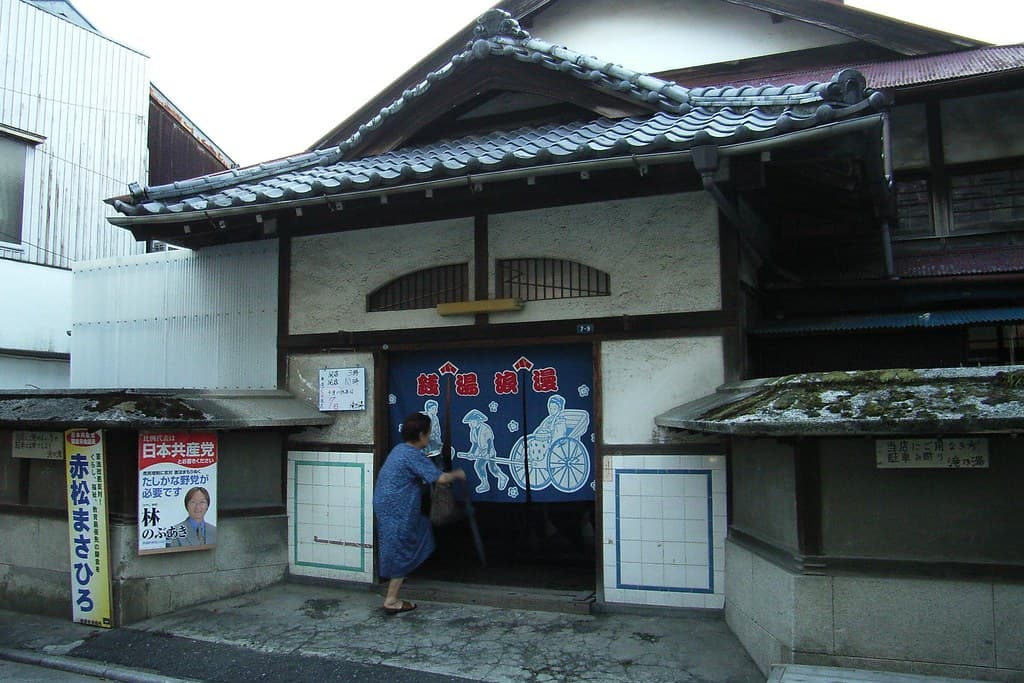
The difference is not size, price or atmosphere — it is the water. Under Japan's Hot Springs Act, water may only be called onsen if it emerges from the ground at 25°C or above, or contains at least one of a listed set of substances above a specified concentration. A sento is a public bathhouse, and in most cases it is heating ordinary tap water.
That single legal fact explains almost every other difference between the two, including why one has a price fixed by the local government and the other does not.
What legally counts as an onsen
The Hot Springs Act (温泉法, enacted 1948) defines onsen as hot water, mineral water, steam or other gas emerging from the ground that meets either of two tests:
- Temperature at the source is 25°C or above, or
- It contains at least one designated substance at or above its specified concentration.
The second list is long and specific. Dissolved solids of 1,000 mg/kg or more qualifies; so does free carbon dioxide at 250 mg/kg or more, lithium ion at 1 mg/kg, total iron at 10 mg/kg, metasilicic acid at 50 mg/kg, and radon above a set threshold, among others.
Two consequences follow that surprise most visitors:
- A cold spring can legally be an onsen. If the mineral content qualifies, temperature is irrelevant — the water is simply heated before you get in.
- Being an onsen says nothing about the building. A concrete facility in a suburb with qualifying water is an onsen; a beautiful century-old wooden bathhouse filling its tubs from the mains is not.
There is a further, stricter category, ryoto (療養泉 — therapeutic springs), used when medicinal benefits are claimed. Meeting the onsen definition alone does not entitle a facility to advertise health effects.
What a sento is
A sento (銭湯) is a public bathhouse operating under the Public Bath Houses Act as an ordinary public bath (一般公衆浴場) — a facility for everyday washing, historically for households without their own bath.
Because it is treated as a piece of daily infrastructure rather than leisure, the entry price is capped by each prefecture. That is why sento admission is strikingly cheap and strikingly consistent across a whole prefecture: it is a regulated maximum, not a market price.
The water is usually heated tap water. Some sento do sit on qualifying springs, in which case they are both a sento and an onsen — and they will say so on the sign.
"Super sento" is a third thing
A super sento (スーパー銭湯) is a large bathing complex with multiple tubs, saunas, restaurants and rest areas. Legally these are usually other public baths (その他の公衆浴場) rather than ordinary public baths, so the prefectural price cap does not apply — which is why admission runs several times a plain sento's.
Whether a super sento is also an onsen depends, again, entirely on the water.
Which should you go to?
| Sento | Onsen | |
|---|---|---|
| Defined by | Its function — an ordinary public bath | Its water — the Hot Springs Act |
| Water | Usually heated tap water | Spring water meeting the temperature or mineral test |
| Price | Capped by prefecture; low and uniform | Set freely; varies widely |
| Where | Residential neighbourhoods, cities | Wherever qualifying springs exist |
| Go for | Everyday life, a hot soak after a long day of walking, tiled murals and local regulars | The water itself, and often the setting |
If you are in Tokyo for four days, the honest recommendation is a sento. It costs almost nothing, it is a five-minute walk from wherever you are staying, and it is the version of this culture that Japanese people actually use on a Tuesday. Save the onsen for a trip that takes you somewhere with real springs.
The etiquette is identical at both
Whatever the legal category, the bathing procedure does not change: undress completely in the gender-separated changing room, wash and rinse thoroughly at a seated shower station before entering any tub, keep the small towel out of the water, and never bring a phone or camera into the changing room.
If this is your first Japanese bath, the full step-by-step — including how tattoo policies differ by facility, which is a house rule rather than a law — is in onsen etiquette for first-timers.
常见问题
- What is the difference between a sento and an onsen?
- An onsen is defined by its water under Japan's Hot Springs Act — it must emerge at 25°C or above, or contain a listed mineral above a set concentration. A sento is a neighbourhood public bathhouse, usually heating ordinary tap water, with entry prices capped by the prefecture.
- Can an onsen be cold?
- Yes. The Hot Springs Act allows water below 25°C to qualify as onsen if it contains at least one designated substance above its specified concentration. Such springs are simply heated before bathing.
- Why are sento so cheap?
- Because a sento operates as an ordinary public bath — treated as everyday infrastructure rather than leisure — its admission price is capped by each prefecture. The fee is a regulated maximum, which is why it is both low and consistent across a whole prefecture.
- What is a super sento?
- A large bathing complex with multiple tubs, saunas and restaurants. It is usually classified as an "other public bath" rather than an ordinary public bath, so the prefectural price cap does not apply and admission costs several times that of a plain sento.