
What Is a Torii Gate? Meaning, Colors, and Why They're Everywhere in Japan
A gate that marks a boundary, not just an entrance
A torii is a simple two-post, two-lintel gate — but its job isn't architectural, it's symbolic. It marks the kekkai, the boundary between the zokukai (the ordinary, secular world) and the shinkai (the divine realm) where a kami, a Shinto deity, is believed to dwell. Walking under one is a small ritual act: you're stepping out of the everyday and into sacred ground, which is why the custom is to bow once before passing through, and again on the way out.
At larger shrines you may pass under more than one. Gates are numbered by how close they sit to the sanctuary — ichi no torii (the first, outermost), ni no torii (second), san no torii (third, closest to the shrine itself) — each one marking a deeper step into sacred space. Along the approach path, or sandō, the center line is called the seichū and is traditionally considered the kami's own path; visitors conventionally walk slightly to one side rather than straight down the middle. At Ise Jingu specifically, that means keeping left in the outer shrine and right in the inner shrine.
Where the word — and the shape — come from
There's no single agreed origin. The most commonly cited literal reading splits 鳥居 into tori ("bird") and i ("to perch"), giving "bird perch." A separate theory derives it instead from tōri-iru, "to pass through and enter." Neither has won out as the definitive answer.
Folklore offers its own origin story, though it should be read as legend rather than history: in the myth of the sun goddess Amaterasu, she hides in a cave and plunges the world into darkness, and roosters are gathered outside to crow and lure her back out. The perch they're said to have sat on is, according to this Shinto legend, the mythic ancestor of the torii.
On where the physical structure came from, scholars are similarly divided. One leading theory points to the Indian torana, a freestanding Buddhist gateway, as the architectural ancestor. Others argue for links to the Chinese pailou, the Korean hongsalmun, or a native Japanese tradition of marking sacred ground with bird-perch-like structures — some scholars hold out for a purely indigenous origin. What is solidly dated is when torii start showing up in writing: the earliest confirmed textual reference is from 922 CE, in the mid-Heian period.
Structurally, torii fall into two broad families. The shinmei type has a straight, unadorned lintel — the style used at Ise Jingu and Kasuga Taisha, among others. The myōjin type has a curved, upswept lintel, often doubled, and is the more elaborate style seen at Inari shrines and many others across the country.
Why red — and why not always red
Vermilion is the color most people picture, and in Shinto tradition it's tied to vitality, the sun, fire, and protection against evil spirits and disease. There's also a practical explanation that circulates widely, though it traces back to travel and culture writing rather than an academic source: traditional red pigment used cinnabar, and its mercury content is credited with helping the wood resist rot, fungus, and insects in Japan's humid climate.
Not every torii is red. Some, most famously the large gates at Meiji Jingu in Tokyo, are left as unpainted cypress — a deliberate aesthetic choice tied to ideas of purity and an unadorned closeness to nature, not simply an absence of decoration. A small minority of shrines use black or dark-stained torii as well, though the reasoning behind that choice is less consistently documented.
Why they're everywhere
The Association of Shinto Shrines oversees roughly 80,000 registered shrines across Japan — and that count only includes shrines with an affiliated priest, so it leaves out countless small roadside and household shrines. Since nearly every one of those shrines has at least one torii, and larger shrines often string together two or three, the true number of torii gates nationwide comfortably exceeds the shrine count itself. No source gives a precise national total, but "tens of thousands of shrines, many with multiple gates" is a fair way to picture the scale.
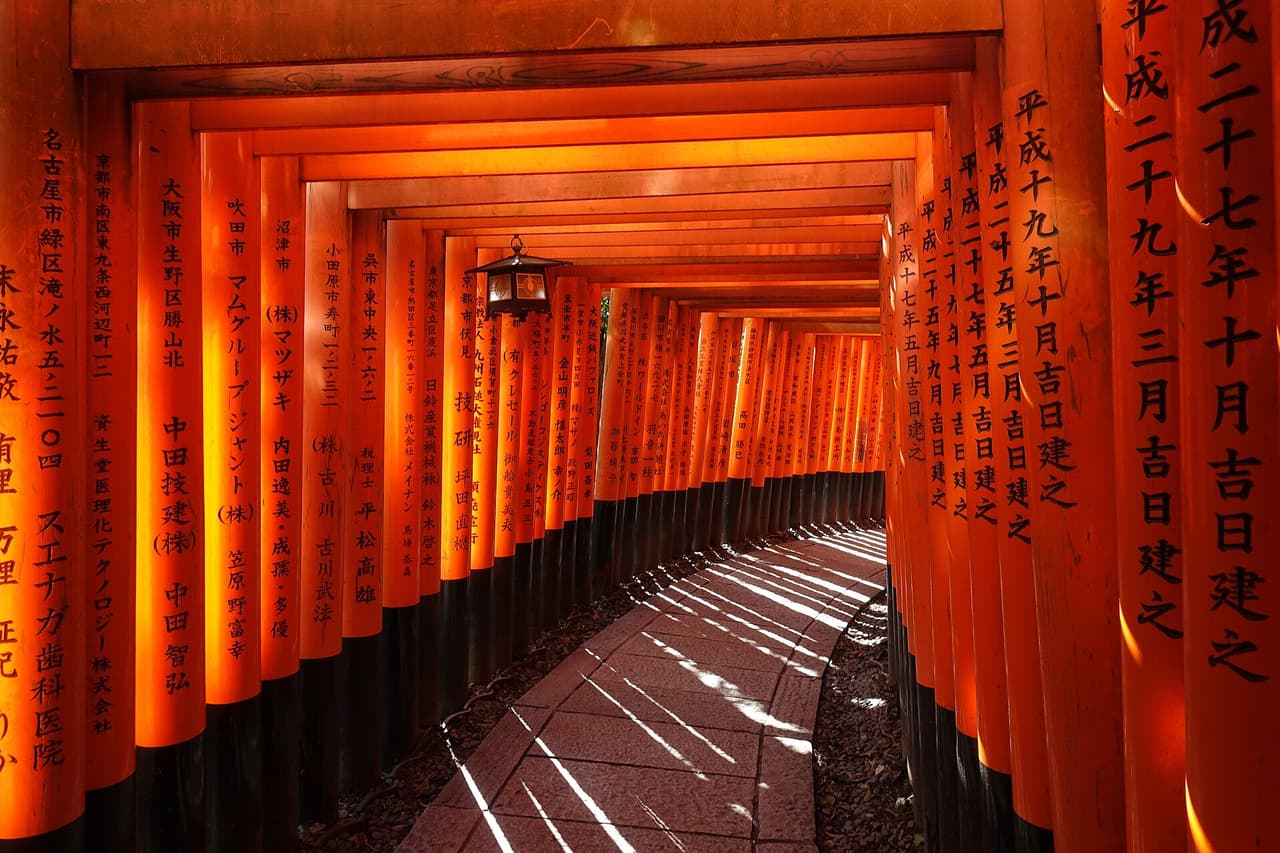
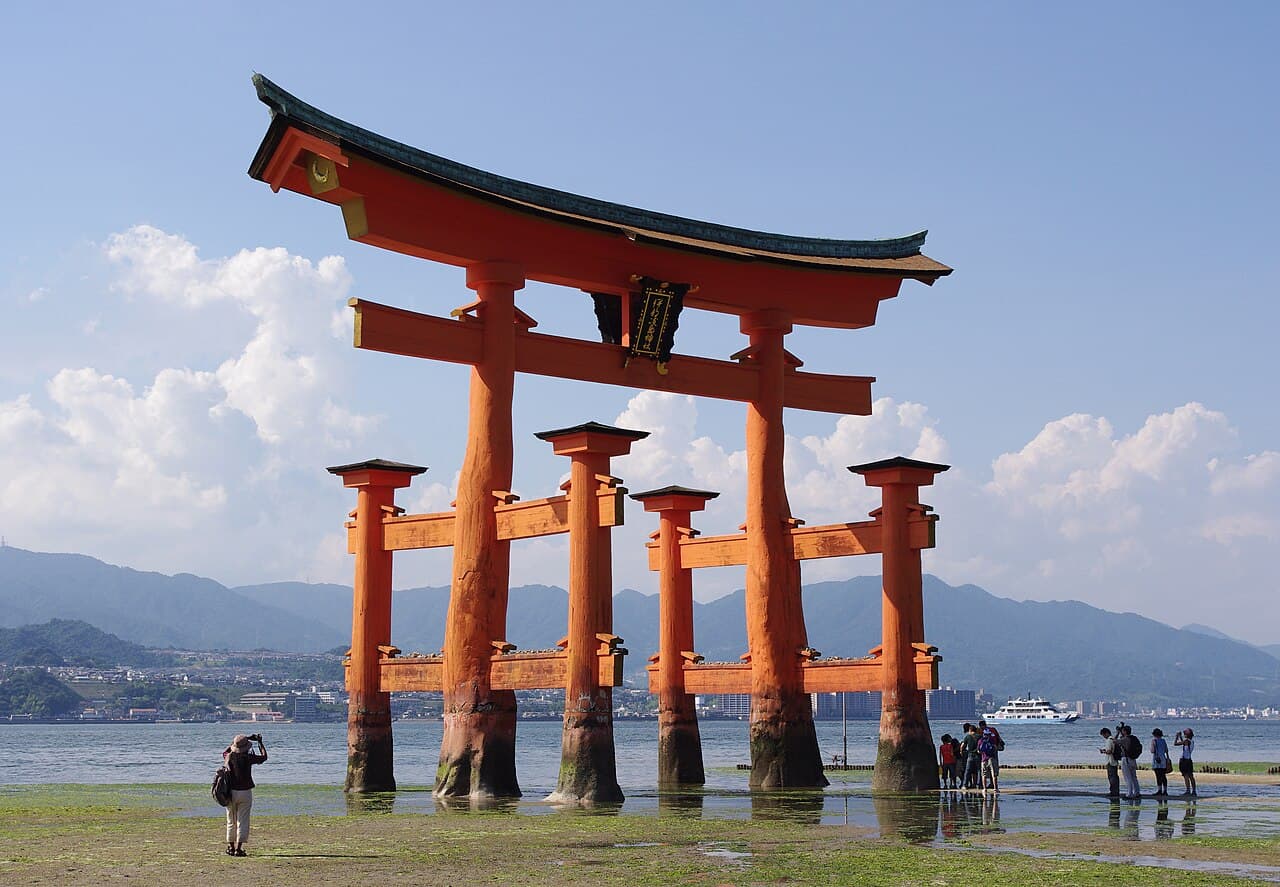
A handful of individual gates are worth knowing by name. Fushimi Inari Taisha in Kyoto, founded in 711 CE, is famous for roughly 10,000 vermilion torii climbing its mountain, about 800 of which form the tightly packed "Senbon Torii" tunnel — each one donated by a company or individual, a custom that spread during the Edo period (1603–1868), with the donor's name and date inscribed on the back. Itsukushima Shrine on Miyajima has the so-called "floating" torii, which appears to hover on the water at high tide: it stands 16 meters tall, 24 meters wide between its main pillars, and weighs roughly 60 tons — including about 7 tons of stone ballast packed into the upper lintel — and isn't anchored into the seabed at all, staying upright purely through its own weight. It reopened in December 2022 after a multi-year restoration, its first major overhaul in about 70 years. The largest torii in the country stands at Kumano Hongu Taisha's Oyunohara site in Wakayama, at 33.9 meters tall and 42 meters wide. And in Nagasaki, a stone torii at Sannō Shrine — about 800 meters from the atomic bomb's hypocenter — had one pillar and half its upper beam torn away by the August 9, 1945 blast, leaving it standing on a single leg. The city has preserved it as a peace memorial.
FAQ
- What does the word torii actually mean?
- The most common explanation reads 鳥居 as tori ("bird") + i ("to perch"), i.e. "bird perch." A competing theory instead traces it to tōri-iru, "to pass through and enter." Scholars haven't settled on one over the other.
- Why are so many torii gates painted red?
- Vermilion is tied in Shinto tradition to vitality, the sun, and protection from evil and disease. It's also often explained as practical: the traditional pigment contained cinnabar, and its mercury content is credited with helping preserve wood against rot and insects in Japan's humid climate — though that specific claim comes from travel and culture sources rather than an academic citation.
- Do all torii gates lead to Shinto shrines?
- Almost all do, but not exclusively — a small number of Buddhist temples, such as Shitennō-ji in Osaka, also have a torii at an entrance. A temple's own signature gate is usually a sanmon, a large roofed structure, rather than a torii.
- How many torii gates are there in Japan?
- No official national total exists. The Association of Shinto Shrines counts roughly 80,000 registered shrines, and since most have at least one torii — larger ones often have two or three in sequence — the real number of gates nationwide is far higher than the shrine count alone.
- What's the oldest torii gate still standing?
- The oldest surviving stone torii dates to the 12th century, at a Hachiman shrine in Yamagata Prefecture. The oldest surviving wooden torii is a ryōbu-style gate built in 1535 at Kubō Hachiman Shrine in Yamanashi Prefecture. The earliest textual mention of a torii at all dates to 922 CE.
Related

How to Pray at a Japanese Shrine: Etiquette, Step by Step
How to pray at a Japanese shrine, step by step: bow at the torii, purify at the temizuya, then two bows, two claps, one bow — plus coins, omamori and omikuji.
Across Japan
Temple vs Shrine in Japan: How to Tell Them Apart & How to Pray at Each
The quickest way to tell them apart: a **shrine (Shinto)** has a **torii gate** and you pray by **bowing twice, clapping twice, bowing once**; a **temple (Buddhist)** has a large **sanmon gate**, incense, and often a pagoda, and you pray **silently, palms together — no clapping.**
Kyoto
The best cultural experiences in Kyoto for first-timers
An honest, first-timer's shortlist of bookable Kyoto cultural experiences — tea ceremony, kimono, zazen, calligraphy and more — with how to choose and what each is really like.