
The short answer
Tokyo gives you two genuinely different soba classes, and the price gap between them is not a quality gap — it is a pricing model gap.
- Kappabashi group class — about US$48.56 per person (listed 2026-08-09), up to 15 participants, at the Matsugaya Center Building in Taito. Hands-on, sociable, and you eat what you cut.
- Tsukiji Soba Academy — conducted entirely in English, priced per group: ¥33,000 for up to three people on the shorter plans, ¥42,900 gluten-free, ¥66,000 for the professional half-day, with supplements above three heads.
Solo, book the first. Three or more, run the arithmetic — the second stops looking expensive fast.
Why soba is the hard one
If you have already done a sushi-making class or a wagashi workshop, you have done assembly and shaping. Soba is different work. Buckwheat has no gluten, so the dough has nothing holding it together — this is precisely why almost all soba is cut with wheat flour, usually at a ratio of eight parts buckwheat to two parts wheat (nihachi). You are fighting a material that wants to crumble.
The three stages:
- Kneading (kikuneri, the "chrysanthemum knead") — you work the dough into a spiral that closes into a cone. This is forearm work and you will feel it.
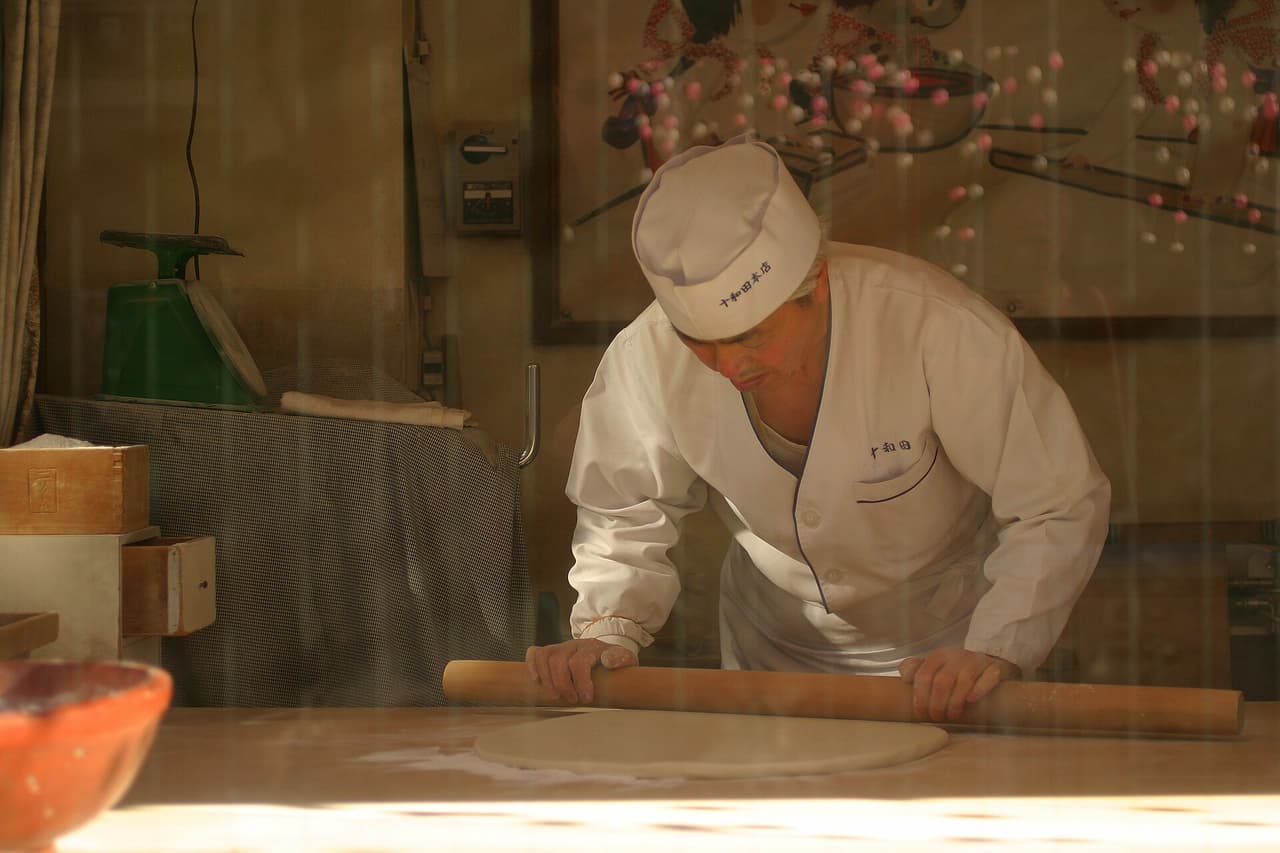
- Rolling — a long thin wooden pin, rolled outward from the centre, until the sheet is even and thin enough to read through. Uneven thickness means noodles that cook unevenly, which is the most common beginner failure.
- Cutting — the moment everyone remembers. The soba-bōchō is a heavy rectangular blade; you fold the sheet, guide the knife along a wooden komaita, and step it over a millimetre or two at a time. Consistent width is the whole game.
Then it boils for about 90 seconds, gets shocked in ice water, and is eaten immediately.
Two rules for eating it
Instructors will not correct you, so here they are.
Slurp. Loudly. Drawing air over the noodles aerates them and lifts the aroma, and it cools them enough to eat at speed. Eating soba silently is not politeness in this context; it reads as indifference to the food.
Drink the soba-yu. At the end you will be brought a lacquer pot of cloudy, starchy water — the water the noodles were boiled in. Pour it into your leftover tsuyu dipping sauce and drink it. It is not for washing anything. Finishing it is as close as soba comes to applauding the cook.
Gluten-free travellers, read this
Soba is one of the most misleading foods in Japan for coeliac travellers, because "buckwheat noodles" sounds safe and almost never is. Standard nihachi soba is 20% wheat. Pure buckwheat jūwari soba exists, but it is harder to make, more fragile, and not what a class will default to.
The practical answer is to book a class that runs a dedicated gluten-free plan — Tsukiji Soba Academy prices one at ¥42,900 for up to three people — rather than turning up and asking. For eating out afterwards, our sister site UMAMI HUNT covers allergy and dietary navigation in Japanese restaurants in detail.
Booking
Both routes are reservation-only. The Kappabashi class caps at 15 and is sold through the OTAs; the specialist caps at 6–12 and books through its own site. If you are weighing up which platform to book through more generally, how to book cultural experiences in Japan sets out what each channel is actually good at.
And if you would rather make something you can keep than something you eat, the knife-sharpening workshop in Asakusa is a ten-minute walk from Kappabashi and pairs unreasonably well with a soba morning.
---
Prices, schedules and booking links on this page were verified as of 2026-08-09. Operators change them without notice — confirm on the booking page before you travel, and tell us if you find something out of date.
- The big soba knife (soba-bōchō) is the moment people remember — a heavy rectangular blade guided along a wooden komaita, cutting the folded sheet into strands
- You eat what you make: freshly cut soba boiled and served, which is a different food from anything sold dried
- The Kappabashi class sits in Tokyo's kitchenware district, so you can buy the knife you just used ten minutes' walk away
- The English specialist lets you take your noodles back to your accommodation rather than only eating on site
- Buckwheat is naturally gluten-free but almost all commercial soba is cut with wheat — which is why a dedicated gluten-free plan is worth knowing about
Two rules from the eating side that instructors quietly appreciate: slurping is expected — it aerates the noodles and cools them, and silent eating reads as indifference — and the *soba-yu*, the cloudy water the noodles were boiled in, is poured into the leftover dipping sauce and drunk at the end. It is not washing-up water. Finishing it is the closest thing soba has to a compliment.
常见问题
- How much does a soba making class in Tokyo cost?
- Around US$48.56 per person for the Kappabashi group class as listed on 2026-08-09. The fully English-language Tsukiji Soba Academy charges per group instead: ¥33,000 for up to three people on its shorter plans, ¥42,900 for the gluten-free plan and ¥66,000 for the professional half-day, with per-person supplements above three.
- Which soba class should I book — the cheap one or the specialist?
- It depends on your group size. Solo or as a couple, the Kappabashi group class is far better value. From three or four people the per-group pricing at the specialist becomes comparable, and you get the class entirely in English with a much smaller ratio. If anyone needs gluten-free, the specialist is the only one of the two that plans for it.
- Is soba gluten-free?
- Buckwheat itself is, but almost all commercial and hand-cut soba in Japan uses wheat flour as a binder — the common ratio is 80% buckwheat to 20% wheat. A pure 100% buckwheat soba (jūwari) exists but is harder to make and less common. If you are coeliac, book a class that runs a dedicated gluten-free plan rather than asking on the day.
- Do you eat the soba you make?
- Yes at both. The Kappabashi class includes tasting what you cut. The specialist lets you take your noodles back to your accommodation as well, and its longer plans include a full Japanese meal.
- Do I need to book a soba class in advance?
- Yes. Both routes are reservation-only and small classes fill, especially in spring and autumn. The Kappabashi class caps at 15 people; the specialist caps at 6 to 12 depending on plan.