
Earthquake in Japan as a Tourist: What to Do, Who to Call, and an Offline Checklist
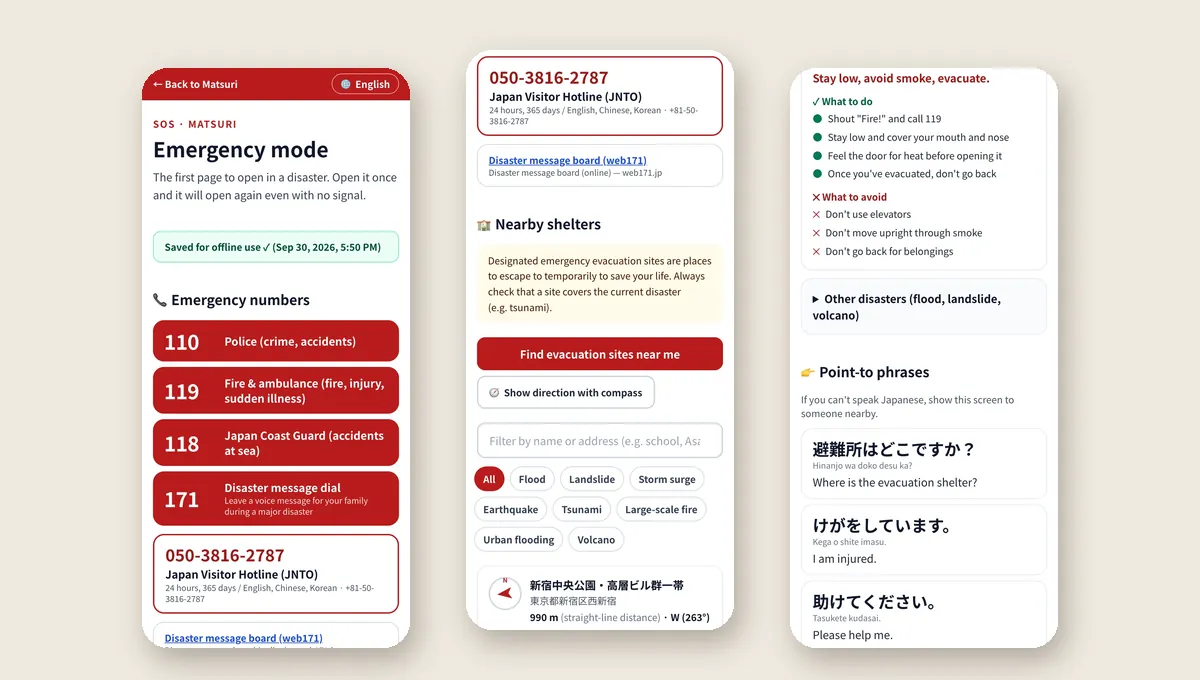
If an earthquake hits while you're in Japan, protect your head and stay where you are until the shaking stops. Don't run outside. If you're near the coast, head for high ground straight away, without waiting to see the sea. For help, call 110 (police) or 119 (fire and ambulance). JNTO's Japan Visitor Hotline, 050-3816-2787, answers 24 hours a day, 365 days a year, in English, Chinese and Korean. Do two things before you need them: install the Japan Tourism Agency's Safety tips app (featured by JNTO) for alerts, and open an offline emergency page once so it still works with no signal. Numbers and official guidance checked against JNTO, NTT and the Japan Coast Guard on 30 September 2026.
Disclosure: the screenshots below are of Matsuri's emergency mode, a free page run by Jon&Coo, the same company that publishes MICHI. We use it because it puts everything on this page on one phone screen. Nothing here depends on it: the numbers, the tsunami-warning timing and the official definitions are sourced to JNTO, NTT, the Japan Coast Guard and the Geospatial Information Authority of Japan (listed at the end). The general steps (shoes, lifts, block walls, not evacuating by car) are standard Japanese safety guidance, which Matsuri's cards also repeat.
The numbers to know
| Number | Who answers | When to call |
|---|---|---|
| 110 | Police | Crime, traffic accidents |
| 119 | Fire and ambulance | Fire, injury, sudden illness |
| 118 | Japan Coast Guard | Accidents and incidents at sea |
| 171 | NTT disaster message dial | Leave or hear a voice message for family after a major disaster |
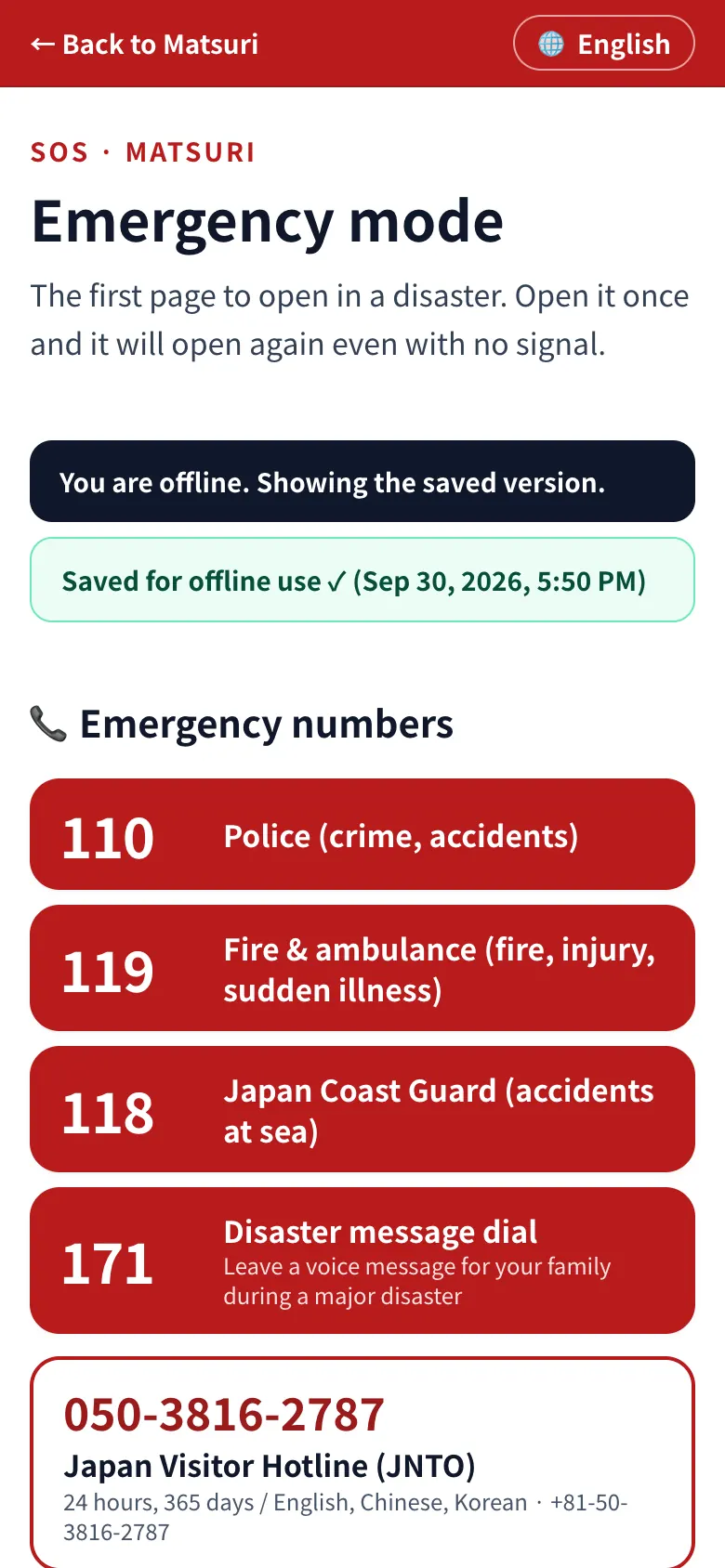
| 050-3816-2787 | JNTO Japan Visitor Hotline | 24/7 help in English, Chinese and Korean |
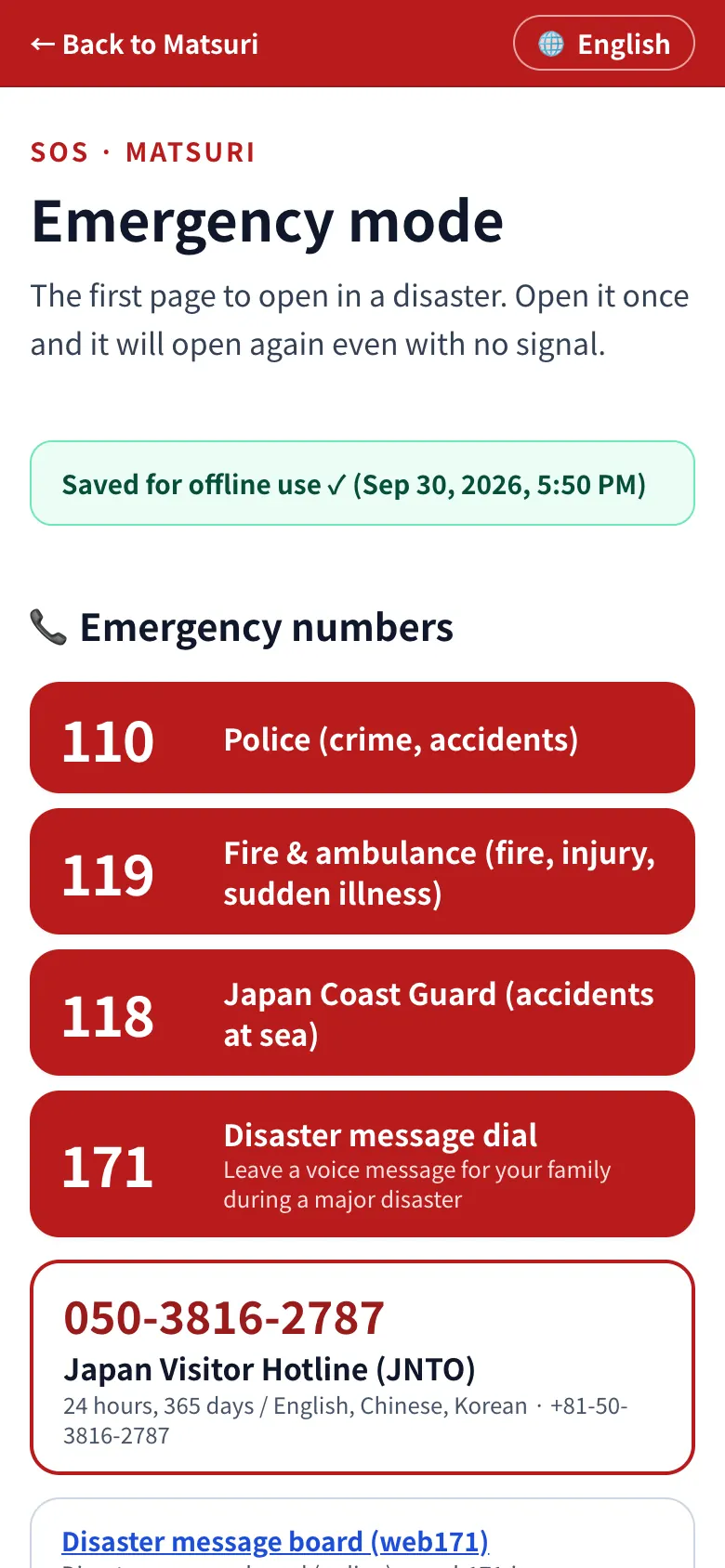
How 171 works: dial 171, press 1 to record a message or 2 to play one back, then enter the Japanese phone number of the person in the disaster area (your own, if you're the one recording). It only runs once NTT activates it after a major disaster, and it works from NTT landlines, payphones and docomo mobiles; from other carriers, including overseas SIMs, it may not. The online version, web171, has an English screen.
During the shaking
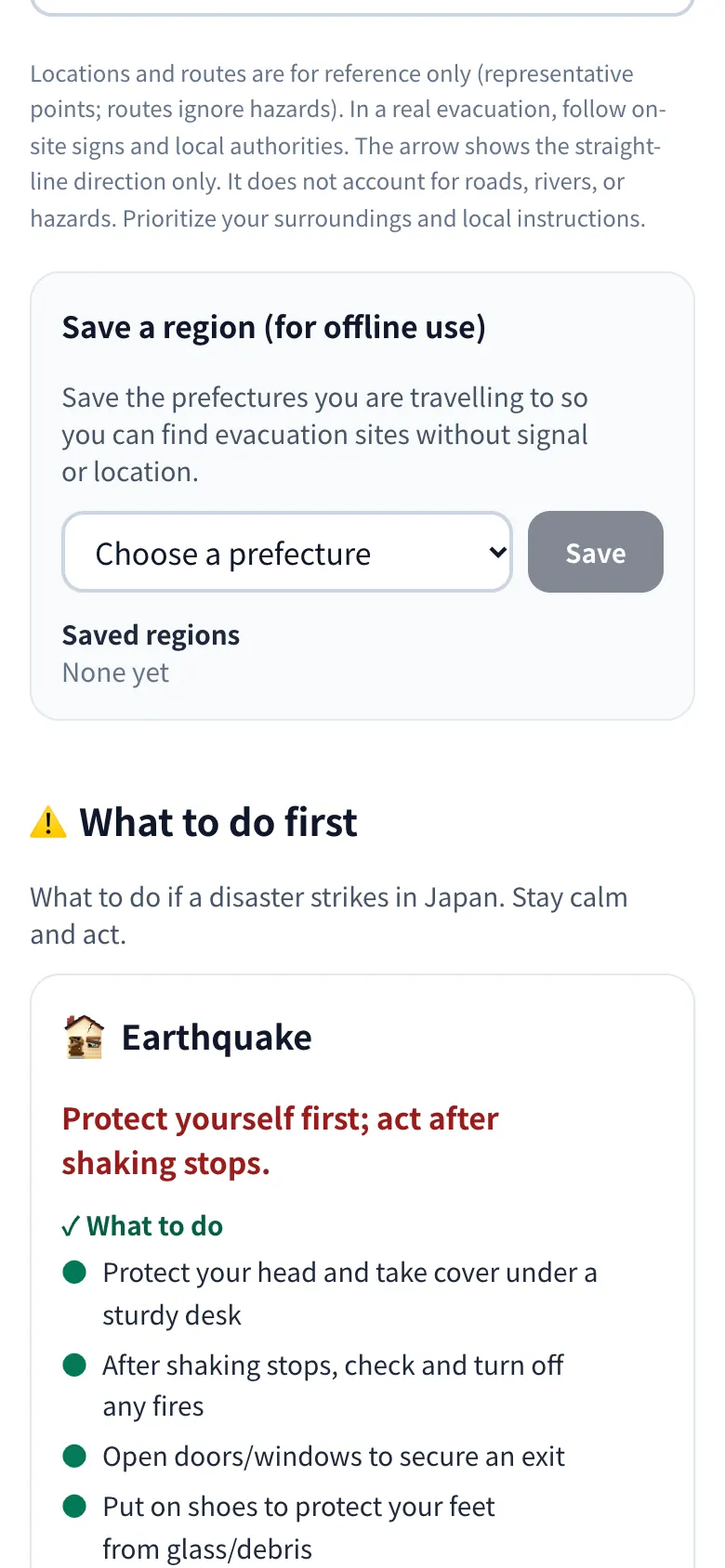
- Protect yourself first. Cover your head and get under a sturdy desk or table. JNTO notes that most buildings in Japan are built to resist earthquakes, so don't go outside until it's safe.
- If an Earthquake Early Warning sounds on TV, radio or your phone (a distinctive alarm), take cover at once, even if you can't feel anything yet.
- Outside: move away from block walls, vending machines and glass. Watch for falling objects.
Right after it stops
- Check for fire, and turn off anything you were using to cook.
- Open a door or window to keep an exit clear.
- Put on shoes. Broken glass and debris make foot injuries common after a quake.
- Don't use lifts (elevators).
If you're near the coast: tsunami
JNTO says the Japan Meteorological Agency issues a tsunami warning about three minutes after an earthquake if it expects damage. Don't wait for it. If the shaking was strong, or weak but long, start moving to high ground or a tsunami evacuation building. Don't go to look at the sea. Don't evacuate by car, because traffic jams trap people. Stay up until the warning is lifted, because tsunamis come in several waves over a long period.
Where to go: evacuation sites vs shelters
Japan uses two different kinds of place, and it's worth knowing the difference:
- Designated emergency evacuation sites are where you flee to save your life right now, such as a park or high ground. Each one is designated for specific hazards, so a site safe in an earthquake may not be safe in a tsunami.
- Designated evacuation shelters are where people stay afterwards, usually schools and community centres. JNTO notes that some hotels and inns take evacuees too, so ask your accommodation.
The Geospatial Information Authority of Japan puts it plainly: when a disaster strikes, go to an emergency evacuation site, not a shelter.
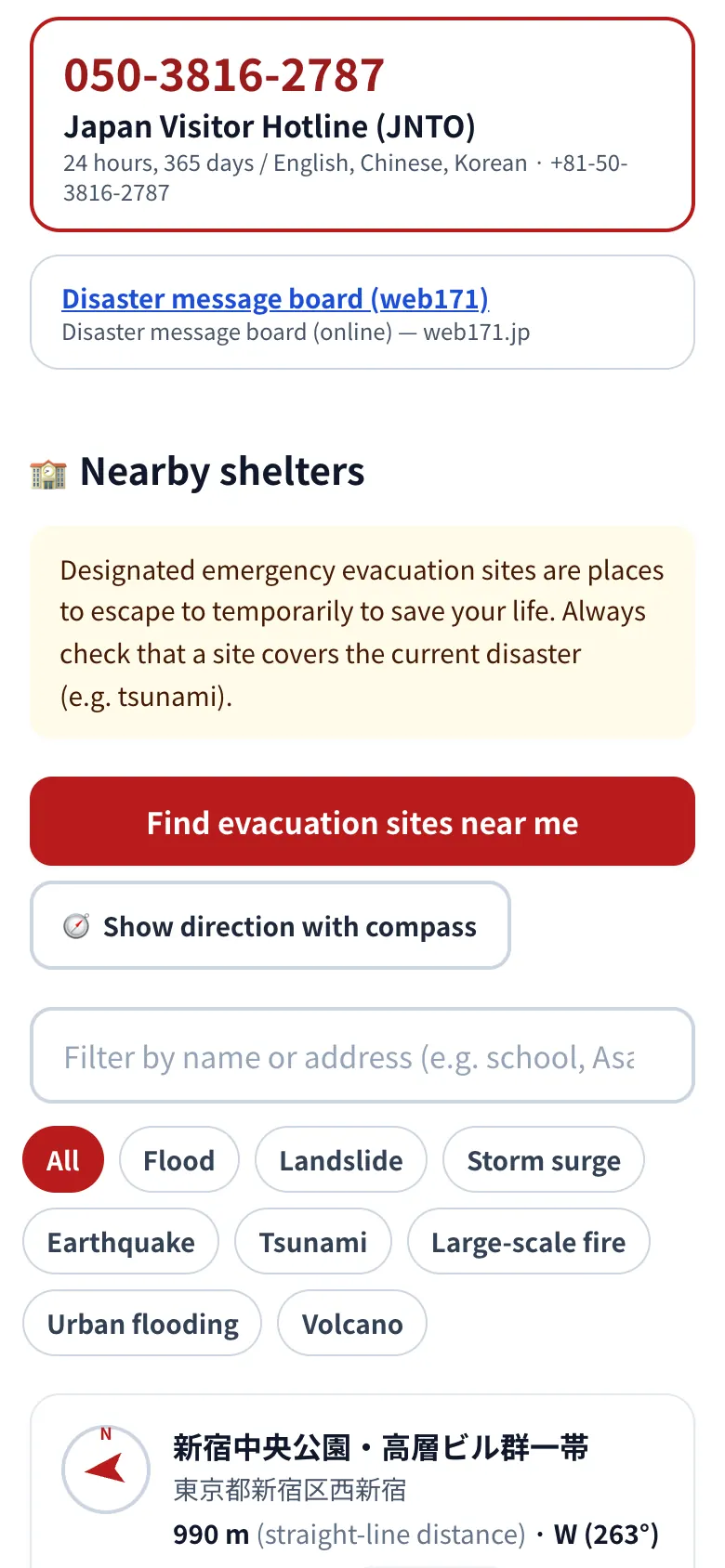
Matsuri's page finds the nearest designated sites from the Geospatial Information Authority of Japan's data (115,417 sites nationwide, updated 12 June 2026). It shows which hazards each site covers, which is exactly the check you need. With the location set to Shinjuku Station, the nearest was the Shinjuku Chuo Park and skyscraper district area, 990 m to the west in a straight line (not a walking route), marked for earthquake and large-scale fire. The page itself warns that locations are for reference: follow signs on the spot and local officials. (Matsuri labels this section "Nearby shelters", but the results are emergency evacuation sites in the sense above.) The page says that if you save your prefecture while you have signal, the site search works offline; we didn't test that part.
If you can't speak Japanese
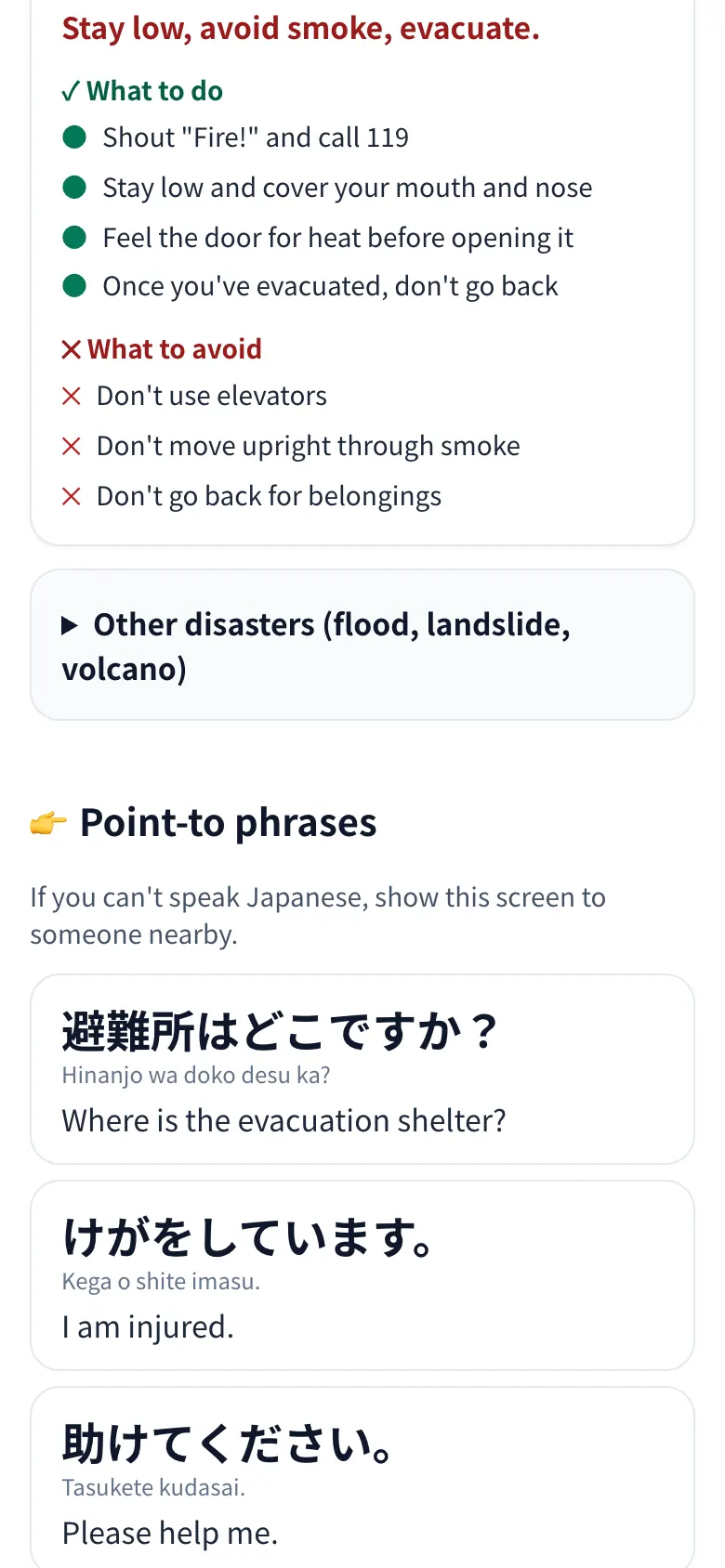
Show the screen instead of speaking. The phrases that matter most:
- 避難所はどこですか? (Hinanjo wa doko desu ka?): Where is the evacuation shelter?
- けがをしています。 (Kega o shite imasu.): I am injured.
- 救急車を呼んでください。 (Kyūkyūsha o yonde kudasai.): Please call an ambulance.
- 英語が話せる人はいますか? (Eigo ga hanaseru hito wa imasu ka?): Is there anyone who speaks English?
Two things to set up before your trip
| JNTO Safety tips app | Matsuri Emergency mode | |
|---|---|---|
| What it is | The Japan Tourism Agency's app, featured by JNTO (iOS and Android) | A free web page (no install, no account) |
| Alerts | Push alerts for earthquake early warnings, tsunami and weather warnings | No alerts from the web page |
| Works offline | Its action flowchart and phrase cards work without a connection (per the developer) | Yes, after one visit. We tested it with the network cut |
| Evacuation information | Links out to a separate shelter app | Nearest sites from GSI data, with the hazards each site covers |
| Languages | 15, including English, Chinese, Korean, Thai and Spanish | Japanese, English, Chinese, Thai, Norwegian, Spanish |
They do different jobs, so set up both: Safety tips to warn you, an offline page to tell you where to go when the network is down. To keep Matsuri's page on an iPhone, open the emergency page in Safari, tap Share, choose Add to Home Screen, then open it once from the new icon while you still have signal.
Sources
- JNTO / Japan Tourism Agency: Safety tips for travelers (building safety, earthquake early warnings, tsunami warnings, designated evacuation shelters) · The Safety tips app · Japan Visitor Hotline
- NTT: Disaster message dial 171 (in Japanese)
- Japan Coast Guard: 118 for incidents at sea (in Japanese)
- Geospatial Information Authority of Japan: Designated emergency evacuation sites and designated evacuation shelters (in Japanese)
- RC Solution (Safety tips developer): Safety tips (offline flowchart and phrase cards; links to an external shelter app; in Japanese)
- Matsuri: Emergency mode (evacuation-site data credited on the page to the Geospatial Information Authority of Japan, CC BY 4.0)
All checked on 30 September 2026. Screenshots captured by MICHI on the same day at phone size in Chrome, with the phone's location set to Shinjuku Station for the shelter search.
--- Update log: 2026-09-30 — first published as part of MICHI's Matsuri feature.
자주 묻는 질문
- What should I do in an earthquake in Japan as a tourist?
- Protect your head, take cover under something sturdy and stay inside until the shaking stops; most buildings in Japan are built to resist earthquakes. Then put on shoes and, if you are near the coast, move to high ground at once.
- What is the emergency number in Japan?
- 110 for police and 119 for fire and ambulance. For 24-hour help in English, Chinese or Korean, call JNTO's Japan Visitor Hotline on 050-3816-2787.
- How do I find an evacuation site in Japan?
- Ask your accommodation, and use a map of designated emergency evacuation sites. Each site is designated for specific hazards, so check it covers the disaster you are escaping, for example tsunami.
- Is there an app for earthquake alerts in Japan in English?
- Yes. The Japan Tourism Agency's free Safety tips app sends push alerts for earthquake early warnings, tsunami and weather warnings in 15 languages, including English.
- How does the 171 disaster message dial work?
- Dial 171, press 1 to record or 2 to play back, then enter the Japanese phone number of the person in the disaster area. It is activated for major disasters and may not work from overseas SIMs; web171 is the online version.
관련
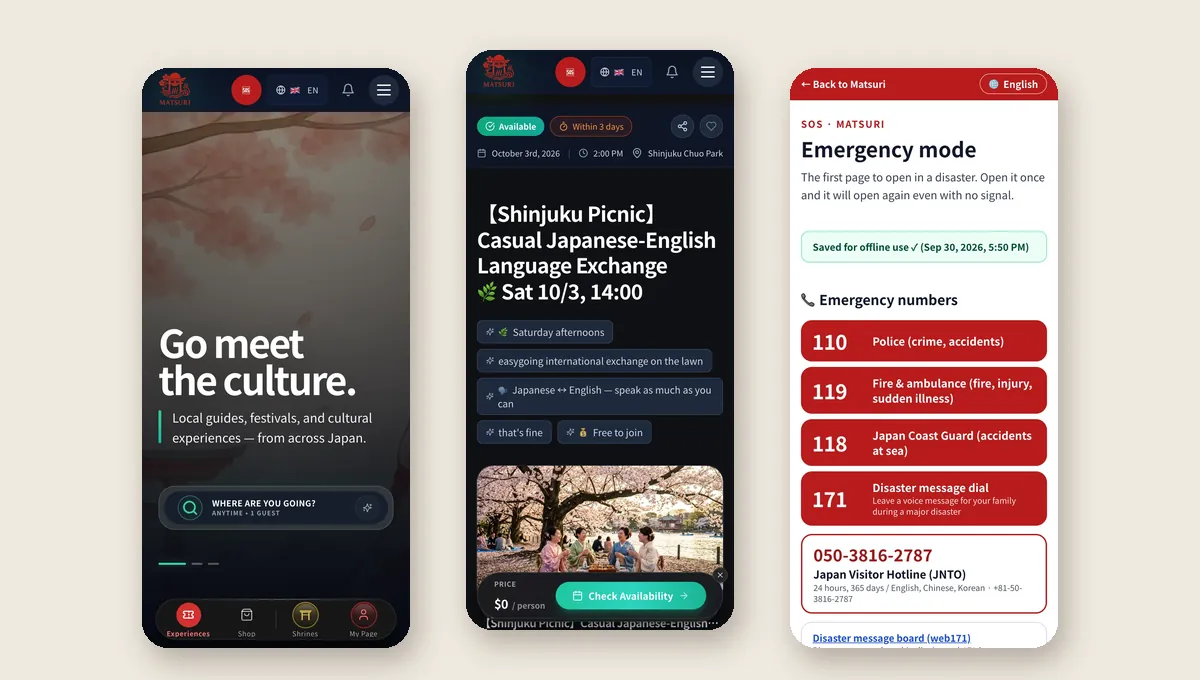
What Is Matsuri? Japan's Culture-Experience App, Screen by Screen (2026)
Matsuri (matsuri.group) bundles guided tours, free meetups, a Japan-made shop, a shrine game and a free offline emergency page. We opened each tab on 30 Sep 2026: what works, what doesn't yet, with screenshots.
Tokyo
도쿄 최고의 전통문화 체험과 예약 방법 총정리
도쿄 최고의 전통 체험에서는 아사쿠사에서 기모노를 입고, 다도에서 말차를 저어 보고, 에도마에 스시를 만들고, 사무라이·닌자 무예를 배우거나 서예·꽃꽂이·킨츠기·다이코를 익힐 수 있습니다. 각 체험이 무엇인지, 그리고 어디에서 예약하는지 정리했습니다.