
The short answer
There are two ways to draw a Japanese bow in Tokyo, and they are not the same sport. Full kyudo on a 28-metre range costs from ¥16,000 per person for about 2.5 hours, equipment and English guiding included. *A private half-bow (hankyu) session in Bunkyō costs from ¥29,900 for the whole group* of up to ten, for 45 minutes. Split four ways the second is cheaper; shot for shot, the first is the real thing. (Prices as of 21 August 2026.)
Most listicles call both of them "kyudo". Only one of them is.
Option 1 — full kyudo, 28-metre range (from ¥16,000, ~2.5 hours)
This is the one to book if you want kyudo as the All Nippon Kyudo Federation defines it: a full 28-metre competition range, in an official dojo, with the proper equipment.
What the operator publishes:
- From ¥16,000 per person, tax included (as of 21 August 2026)
- About 2.5 hours
- Full 28-metre competition range
- English and Japanese
- Age 13 and over
- Included: guide fee, facility usage fee, and rental of a complete equipment set
- Optional: buy a hakama for ¥20,000 — cash only, and non-cancelable once ordered
Two logistics worth knowing before you commit. The session runs at official kyudo dojos across Tokyo's 23 wards and neighbouring cities, and the exact venue is confirmed to you a few days beforehand, typically somewhere within about 30 minutes of Tokyo Station — so do not book a restaurant next door in advance. And late arrivals cannot join, with no refund. Kyudo runs on a shooting order; a person walking in mid-session breaks it for everyone.
Photography and video are restricted during the session, and the venue is not wheelchair accessible.
Who it suits: anyone who came for the discipline. If you already train in archery, a martial art, or shooting of any kind, this is the version that will give you something to compare against. It sits naturally next to kendo and zazen in a Tokyo itinerary built around practice rather than sightseeing.
Option 2 — Hankyu Dojo Yumiyasan, Hongō (from ¥29,900 per group, 45 min)
Be clear about what this is, because the name in the search results will not make it clear. *Yumiyasan is a hankyu dojo — a half-bow, not the full-length kyudo bow.* The venue describes itself as the only hankyu dojo in Tokyo, and notes that where other hankyu halls have you draw from a seated position, here you draw standing.
It is a genuinely good hour. It is not 28-metre kyudo.
- From ¥29,900 per booking (as of 21 August 2026) — the course line reads "1–10 people, 45 minutes", and the venue is taken privately for your group
- 45 minutes, reduced by 10 minutes if you change into a kyudo uniform
- 2-23-4 Hongō, Bunkyō-ku — 3 minutes on foot from Hongō-sanchōme Station on the Marunouchi Line
- Age 4 and up — with a maximum of three pre-school-age children per group
- Web reservations only. Not by email, not by LINE. The window runs from 30 days ahead to 30 minutes before
- Credit card required — there is no paying cash on the day
- Once booked, the date and the number of participants cannot be changed
One inconsistency to resolve at booking: the course line says 1–10 people, while another part of the site asks groups of five or more to make contact in advance. If you are a party of five or more, message them first.
The arithmetic that matters. ¥29,900 alone is expensive for 45 minutes. ¥29,900 split between four people is about ¥7,475 each, and between eight it is under ¥3,800 — for a private venue, with a four-year-old allowed to shoot. This is a family and small-group option, priced as one. As a solo traveller, book option 1.
Which one you actually want
| Full kyudo (option 1) | Hankyu, Yumiyasan (option 2) | |
|---|---|---|
| The bow | Full-length Japanese bow | Hankyu — half-bow |
| Distance | 28 m, competition range | Short range, indoors |
| Time | ~2.5 hours | 45 min |
| Price | From ¥16,000 per person | From ¥29,900 per group of up to 10 |
| Minimum age | 13 | 4 |
| Venue | Confirmed a few days ahead | Fixed, Hongō-sanchōme |
| Best for | Anyone serious about the form | Families, small groups, short slots |
If you have a half-day and came for the practice, option 1. If you have small children, a fixed schedule, or a group of four or more, option 2.
What the session is actually teaching
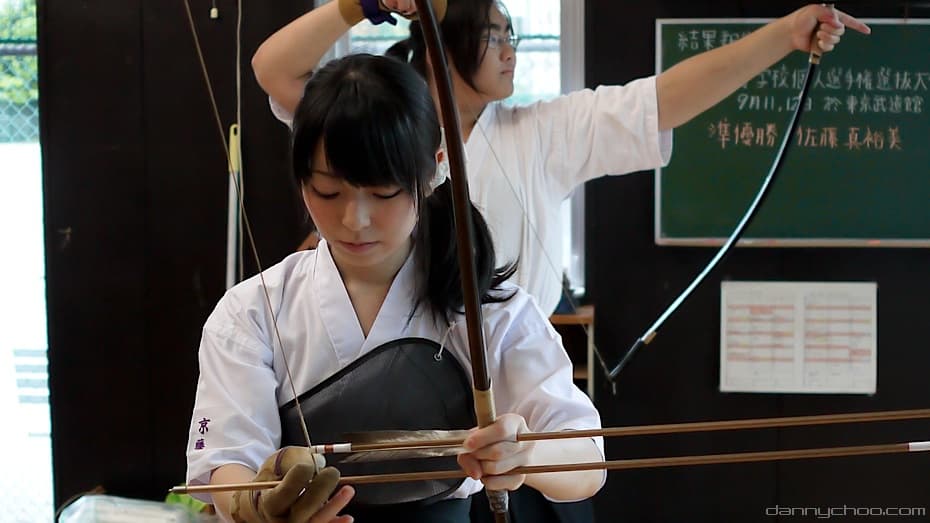
Both sessions run on the same eight-stage form the All Nippon Kyudo Federation calls the shahō hassetsu: ashibumi (set the feet), dōzukuri (settle the body), yugamae (set the bow and look at the target), uchiokoshi (raise both fists to the same height), hikiwake (draw evenly to both sides), kai (hold, until body and mind are one and the release ripens), hanare (open the chest and let the arrow go), and zanshin (hold the posture after the arrow has gone).
Six of those eight happen before the arrow leaves. That ratio is the whole point, and it is why an instructor will spend more of your paid hour on your feet and your shoulders than on where the arrow landed.
You will wear a yugake, the deerskin glove on the right hand, and shoot from a marked position called the shai. If you want the full explanation of the bow, the target, and why kyudo is scored the way it is, read what is kyudo first — it will make the paid hour go further.
Before you book
What to wear. Something you can raise both arms in, freely, above shoulder height. Nothing loose on the left forearm — the string travels there. Bring socks: you will take your shoes off.
Etiquette. Bow entering and leaving the shooting floor. Never point a drawn bow off the range, even without an arrow. Do not step over equipment on the floor. Ask before photographing anyone; at option 1 photography is restricted during the session anyway.
Physical demands. Low. Beginner bows are light, and this is a posture sport. Tell the operator at booking if you have a shoulder, elbow or back problem — the draw is wide and sustained, and that is the part that finds an old injury.
More of Tokyo's hands-on traditions are collected in cultural experiences in Tokyo.
- Option 1 is a full 28-metre competition range in an official dojo — the distance the All Nippon Kyudo Federation defines as standard
- English and Japanese guiding, all equipment included, age 13 and over
- Yumiyasan is a hankyu (half-bow) dojo, not full kyudo — it says so itself, and most listicles do not
- Yumiyasan lets you draw standing, where other half-bow halls have you shoot seated, and takes children from age 4
- Yumiyasan is web-booking only, card only, 30 days ahead to 30 minutes before, with no date or headcount changes after booking
Bow entering and leaving the shooting floor, and never point a drawn bow off the range even with no arrow on the string. Do not step over equipment lying on the floor. Kyudo runs on a shooting order, which is why the full-range operator refuses late arrivals without refund — arriving on time is itself the etiquette. Photography and video are restricted during the full-kyudo session; ask before photographing anyone.
FAQ
- How much does a kyudo experience in Tokyo cost?
- From ¥16,000 per person, tax included, for about 2.5 hours on a full 28-metre range with English guiding and all equipment. The half-bow dojo in Hongō is priced per group instead: from ¥29,900 for one to ten people for 45 minutes, which works out around ¥7,475 each for four people. Both checked 21 August 2026.
- Is the Hongō half-bow dojo the same as kyudo?
- No, and the dojo is honest about it. Yumiyasan is a hankyu (half-bow) venue — a shorter bow at short range — while kyudo proper is shot with a full-length bow at 28 metres. Yumiyasan is unusual in letting you draw standing, where other half-bow halls have you shoot seated. It is a good 45 minutes; it is just not the same thing.
- What happens if I am late?
- For the full-kyudo option, you cannot join and there is no refund. This is not commercial harshness: kyudo runs on a shooting order, and someone walking in mid-session interrupts every archer on the line.
- Where exactly is the full kyudo session held?
- At official kyudo dojos across Tokyo's 23 wards and neighbouring cities, usually within about 30 minutes of Tokyo Station. The exact venue is confirmed to you a few days before, so do not book anything that depends on a specific address for the hours either side.
- Can children do kyudo in Tokyo?
- The full 28-metre session is age 13 and over. The Hongō half-bow dojo takes children from age 4, with a maximum of three pre-school-age children per group — that is the family option.
- Is kyudo physically hard?
- Less than it looks. Beginner bows have a low draw weight and this is a posture and patience sport rather than a strength one. Tell the operator at booking about any shoulder, elbow or back problem: the draw is wide and held, and that is what finds an old injury.